
Most people enter peptide therapy assuming the hardest part is finding a supplier. In reality, the hardest part is knowing whether what you're taking actually works for your specific goals. The gap between a peptide's biological rationale and its proven human outcomes is enormous, and most optimization communities paper over it with anecdotes. This guide cuts through that noise by walking you through how to evaluate clinical evidence, understand delivery mechanics, build individualized protocols, and use mobile technology responsibly so your peptide investment is grounded in science rather than speculation.
Table of Contents
- What defines peptide effectiveness?
- The reality of performance and recovery peptides
- Peptide effectiveness: Mechanisms, delivery, and limitations
- Individualized protocols and mobile technology: Opportunities and risks
- Detection, regulation, and anti-doping realities
- What most people miss about peptide effectiveness
- Get started with evidence-based peptide personalization
- Frequently asked questions
Key Takeaways
| Point | Details |
|---|---|
| Clinical evidence matters | Human trials are the gold standard for judging peptide effectiveness and safety. |
| Popular peptides are often investigational | Most performance and recovery compounds lack robust human outcome evidence. |
| Mechanism is not outcome | Biological plausibility alone doesn’t guarantee real-world performance gains. |
| Personalization requires safeguards | Mobile protocols should incorporate quality checks and evidence-based selection to ensure safety. |
| Regulation and detection challenges | Athletes should be aware of regulatory bans and detection limitations for peptide hormones. |
What defines peptide effectiveness?
To understand peptide potential, first clarify what "effectiveness" means in the scientific and consumer worlds. These two definitions are not the same, and confusing them is exactly how people waste months on protocols that were never backed by solid data.
In science, effectiveness requires a controlled human trial with a defined endpoint. That endpoint might be reduced inflammation markers, faster tendon repair on imaging, or measurable improvements in VO2 max. Without it, you have mechanistic plausibility, which means the biology makes sense on paper, but you do not have proof. A peptide can have a compelling mechanism, trigger the right receptors in a cell culture study, and still fail completely in a randomized human trial. This happens constantly in pharmaceutical development.
There is a clear distinction between peptides with strong clinical evidence and the many performance and recovery peptides sold for optimization that often lack well-controlled human outcome trials. Approved therapeutic peptides like insulin, oxytocin, and semaglutide went through rigorous multi-phase trials. Many enhancement compounds have not.
| Category | Evidence level | Example | Human trial data |
|---|---|---|---|
| Approved therapeutic | High | Semaglutide, insulin | Phase III trials completed |
| Investigational clinical | Moderate | Epithalon, Selank | Limited pilot studies |
| Performance/recovery | Low to moderate | BPC-157, TB-500 | Mostly preclinical |
| Novel/unvalidated | Very low | Many new analogs | Near zero |
What makes this especially complicated for optimization users is the concept of "stack" claims. Sellers often combine multiple peptides and claim synergistic outcomes, but endpoint data for combinations is nearly nonexistent. Each compound in a stack would need independent validation, let alone validation as a combined protocol. Understanding peptide therapy evidence before building any stack is not optional. It is the foundation.
A few practical criteria to assess any peptide:
- Does it have published human trials with measurable endpoints?
- Is it approved or under active clinical investigation by a regulatory body?
- Are the studies peer-reviewed and replicated by independent labs?
- Are the reported dosing ranges consistent across studies?
When a peptide fails on most of these criteria, that does not mean it is useless. It means you are working with incomplete data, and your protocol needs to reflect that uncertainty. Understanding explaining peptide efficacy in honest terms is the starting point for responsible use.
The reality of performance and recovery peptides
Now that we have separated evidence from hype, let's look at how this plays out with popular performance peptides. BPC-157 is the clearest example in the optimization community because it is extremely popular, has a genuinely fascinating mechanism, and still has almost no human outcome data.
BPC-157, short for Body Protection Compound-157, is a synthetic pentadecapeptide derived from a gastric protein. Animal studies suggest it promotes angiogenesis (new blood vessel formation), accelerates tendon and ligament healing, reduces inflammation, and may even have neuroprotective effects. The preclinical data is legitimately compelling. For anyone dealing with a nagging joint injury or tendon issue, those results are exciting to read.

Here is the problem: preclinical promise does not automatically translate to clinical effectiveness. Published human data for BPC-157 are extremely limited. Reviews categorize it as investigational with a clear need for rigorous large-scale trials. The leap from a rat tendon study to a human recovery protocol is substantial. Biological systems differ, dosing extrapolation is unreliable, and human trials sometimes reveal safety signals that animal data never surfaced.
If you are considering BPC-157, understanding that preclinical data does not confirm human effectiveness should shape how you approach your protocol design. This means shorter cycles, lower doses, thorough tracking, and honest assessment of whether you are seeing actual measurable change.
Here is a practical framework for approaching investigational recovery peptides:
- Define your baseline. Get objective data before you start, whether that is imaging, range of motion measurements, or biomarkers.
- Set a specific endpoint. Decide in advance what success looks like and at what timeframe.
- Keep a detailed log. Track dose, injection site, sleep, HRV, and any subjective changes daily.
- Establish a stop condition. If nothing measurable changes in 8 to 12 weeks, that is data, not a failure of belief.
- Consult a clinician. Especially for off-label investigational compounds, a physician should be in your loop.
Pro Tip: Use a standardized pain or function scale at the start and end of any BPC-157 cycle. Subjective impressions like "it feels better" are almost impossible to interpret. A validated scale gives you comparable, honest data.
The BPC-157 usage workflow matters as much as the compound itself. Reviewing the essential peptides for performance can help you prioritize compounds where the evidence is stronger and reserve investigational peptides for specific, well-tracked use cases.
Peptide effectiveness: Mechanisms, delivery, and limitations
Having seen evidence gaps, we must also address the science behind how peptides work and why some fail in practice even when the preclinical data looks promising. This is where pharmacodynamics, delivery, and formulation come in.
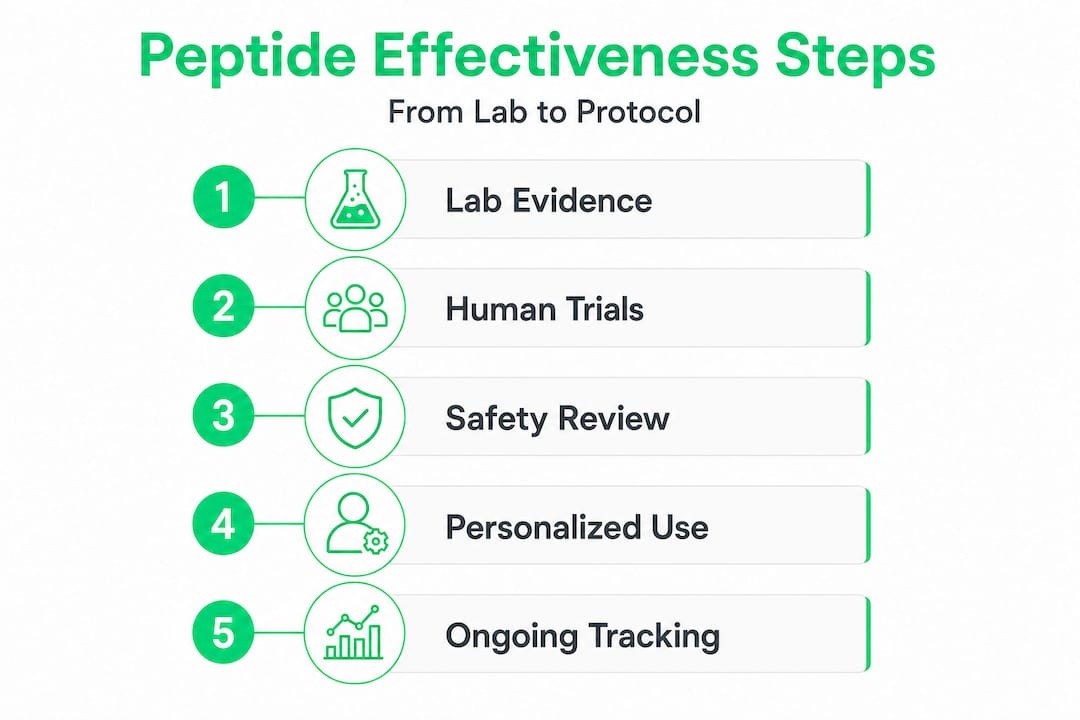
Peptide effectiveness depends on target engagement, delivery and ADME constraints, and chemical or formulation strategies. ADME stands for absorption, distribution, metabolism, and excretion. These four processes determine how much of your dose actually reaches the target tissue at the concentration needed to do anything useful.
Peptides face several significant pharmacokinetic challenges:
- Short half-life. Most peptides are broken down rapidly by proteases (enzymes that cleave proteins) in the bloodstream, often within minutes to hours.
- Poor oral bioavailability. The gastrointestinal tract is designed to digest proteins and peptides. Taking most peptides orally means they are destroyed before absorption. Injectable or intranasal routes bypass this.
- Limited cellular uptake. Even when a peptide survives long enough to reach a tissue, getting inside cells (when intracellular action is required) is a different challenge.
- Salt form sensitivity. Many peptide compounds have different activity profiles depending on their salt form, which affects stability and solubility.
The formulation strategy matters as much as the molecule itself. A peptide with excellent receptor affinity can have zero clinical impact if it degrades before reaching its target.
Formulation strategies that address these limitations include PEGylation (attaching polyethylene glycol to extend half-life), cyclization (creating a ring structure that resists enzyme degradation), and lipidation (attaching fat-soluble groups to improve membrane penetration). Some newer analogs are designed specifically to survive oral delivery, though this remains technically difficult.
For practical users, understanding these limitations changes how you evaluate a protocol. Subcutaneous injection is the gold standard for most peptides because it bypasses the gut while providing a slow, sustained release into the bloodstream. Timing matters too. Some peptides should be dosed around workouts. Others need to be taken on an empty stomach or at night to align with natural hormonal rhythms. Reviewing performance peptide examples with their specific dosing considerations gives you a much clearer picture than relying on generic advice.
Pro Tip: Ask your peptide supplier for a certificate of analysis (COA) from a third-party lab. It confirms purity, correct molecular weight, and absence of contaminants. Without it, you cannot know if you are injecting what the label claims. Understanding peptide supplement types and their delivery differences is essential for protocol accuracy.
Individualized protocols and mobile technology: Opportunities and risks
After reviewing the mechanics and evidence, the natural next step is understanding how technology shapes personalized protocols and what safeguards are essential. Mobile tools have genuinely changed what is possible for individual users, but they have also introduced new ways to make expensive, potentially dangerous mistakes.
Any individualized protocol delivered via mobile technology still must incorporate evidence-grade selection of compounds, verification of product quality and identity, and monitoring plans for safety endpoints. That is not a caveat. It is the baseline requirement for responsible personalization.
What good mobile-supported personalization looks like:
- Evidence-grade compound selection. The app should catalog peptides with their evidence tier clearly labeled, not just present every compound as equally validated.
- Biometric integration. Connecting wearables like Oura Ring or Whoop gives you continuous data on HRV, sleep quality, and recovery scores that tell you whether your protocol is actually working.
- Dosing precision and scheduling. Logging exact doses, timing, and injection sites removes the guesswork that leads to both underperformance and accidental overdosing.
- Safety monitoring prompts. A good protocol includes regular check-in prompts for side effect tracking and scheduled lab reviews.
- Quality verification reminders. The tool should remind you to verify your source's COA rather than assuming all batches are equivalent.
The risk of mobile personalization is that it can create a false sense of scientific rigor. A beautifully designed app logging your BPC-157 injections does not make the compound more evidence-based. The technology is only as good as the protocol underneath it. Guesswork personalization, where you adjust doses based on how you "feel" without baseline data or valid tracking methods, is just guesswork in a prettier interface.
Tracking peptide biomarkers throughout your protocol gives you real signals to act on. Learning safe peptide stacking principles before adding compounds protects you from compounding unknown risks. And understanding what peptide therapy apps can and cannot realistically deliver helps you set honest expectations before you invest.
Detection, regulation, and anti-doping realities
Even perfect protocols must contend with regulatory and anti-doping realities, especially for competitive athletes. This section matters even if you are not a competitive athlete, because the regulatory landscape shapes compound availability, legal status, and product quality standards.
In sport, peptide hormones and related substances are broadly banned by the World Anti-Doping Agency (WADA). This includes growth hormone releasing peptides (GHRPs) like GHRP-6 and GHRP-2, insulin-like growth factor analogs, and numerous other performance compounds. The detection challenges for peptide hormones are significant and differ substantially from androgen detection. Detection windows are often very short because peptides are cleared rapidly from the body. Many peptide hormones require blood testing rather than urine because concentrations in urine are too low to reliably detect.
Key regulatory and anti-doping realities to understand:
- WADA's Prohibited List covers classes of peptides, not just named compounds. A novel peptide analog with a similar mechanism to a banned substance may still be prohibited under "related substances" language.
- Urine tests miss many peptides entirely. Blood testing has better sensitivity, but collection windows are narrow, sometimes just hours.
- Regulatory status varies by country. A compound legal to possess in one jurisdiction may be a controlled substance in another, particularly when crossing into therapeutic territory.
- "Research chemical" labeling does not create legal protection. Selling peptides with "not for human consumption" labels is a legal strategy, not a safety guarantee.
For athletes subject to testing, the practical reality is that using any peptide outside of a therapeutic use exemption (TUE) granted by a governing body carries real risk. Even peptides not explicitly named on the WADA list may trigger a positive result under the catch-all category language. Understand your sport's specific rules before adding any peptide to your protocol.
What most people miss about peptide effectiveness
With the evidence laid out, here is what most practitioners and users tend to overlook. The core mistake is treating mechanistic plausibility as equivalent to proven effectiveness. When you read a study showing that BPC-157 upregulates a growth factor in rat tissue, that is fascinating biology. It is not a protocol recommendation.
Most optimization protocols are only as good as their underlying evidence and quality checks. This sounds obvious until you realize that almost everyone building a stack starts from dosing forums rather than primary literature. Technology is not a substitute for that foundational work. In fact, mobile personalization can amplify both benefits and risks simultaneously. A user who tracks obsessively but uses poorly sourced compounds, skips baseline labs, and never adjusts based on biomarker data is generating a lot of data about a fundamentally flawed protocol.
The users who see durable outcomes treat peptide therapy the way researchers treat drug development: iteratively, skeptically, and with rigorous outcome tracking. They are not married to a compound because it feels good conceptually. They update their protocols based on what the data actually shows.
Mobile tools are powerful exactly because they make that iterative, data-driven approach accessible without a clinical research infrastructure behind you. But the discipline of treating safe peptide evidence as non-negotiable cannot be outsourced to the app. That discipline has to come from you.
Get started with evidence-based peptide personalization
Moving from theory to practice is where most people get stuck. You understand the evidence landscape, you know the delivery mechanics, and you recognize the regulatory risks. The next step is building a protocol that actually reflects all of that knowledge in your day-to-day tracking.

Peptide AI is built specifically for this moment. The app catalogs 50+ peptides with evidence-tiered data, so you can see exactly where each compound sits on the clinical evidence spectrum before you add it to your stack. The AI Insights Chatbot gives you real-time, data-backed answers to protocol questions. The AI Body Scanner tracks your physical transformation over time with objective visual data. And seamless wearable integration with Apple Health, Oura Ring, and Whoop means your biometric data feeds directly into your protocol management. This is research-grade peptide intelligence in your pocket, designed to make your personalization precise, safe, and genuinely evidence-grounded.
Frequently asked questions
How can I tell if a peptide has strong clinical evidence?
Peptides with strong clinical evidence are those validated in human outcome trials with defined endpoints, typically backed by regulatory approval or active clinical investigation. Look for peer-reviewed Phase II or Phase III trial data, not just animal studies or mechanistic reviews.
Is BPC-157 proven effective for muscle recovery?
Human evidence for BPC-157 is extremely limited, and it remains investigational pending larger controlled trials. Most published data comes from animal studies, which means dosing, safety, and efficacy in humans are still largely unconfirmed.
What are the main risks with personalized peptide therapy apps?
The primary risks include insufficient evidence-grade compound selection and lack of rigorous safety monitoring, since personalized protocols require verified product quality and defined safety endpoints to be genuinely responsible. An app that logs doses without addressing those fundamentals can create false confidence in an unsafe protocol.
How are peptides detected in anti-doping sport tests?
Detection sensitivity and windows are substantially different for peptide hormones than for androgens, with many peptides requiring blood testing and offering only narrow detection windows due to rapid clearance. WADA's prohibited list covers classes of peptides, meaning novel analogs of banned compounds may still trigger a positive result.