
Many people exploring peptide therapy make the same mistake: they see a compelling mechanism of action in a lab study and assume it translates directly into real human results. It doesn't. Peptide efficacy describes the extent to which a peptide produces a desired biological or clinical effect, and that definition carries enormous weight. A peptide can bind its receptor perfectly in a test tube and still fail to move the needle in your bloodstream, your muscle tissue, or your recovery timeline. Understanding exactly where and why that gap exists is the foundation for any intelligent peptide decision.
Table of Contents
- Defining peptide efficacy: From lab to real-world results
- Factors influencing peptide efficacy
- Clinical evidence for peptide efficacy: Approved vs. research-grade products
- Interpreting nuanced evidence and trial designs
- Practical wisdom: What most guides leave out about peptide efficacy
- Next steps: Find evidence-based peptide guidance
- Frequently asked questions
Key Takeaways
| Point | Details |
|---|---|
| Efficacy is evidence-driven | True peptide efficacy depends on rigorous clinical trials and measurable effects, not just biological mechanisms. |
| Barriers impact real-world effectiveness | Short half-life, instability, and delivery challenges often limit peptide outcomes without careful formulation. |
| Approved drugs are safer bets | FDA-approved peptides offer clearer evidence and regulatory oversight compared to research-grade alternatives. |
| Trial design affects data quality | The structure of clinical trials (randomized vs. open-label) strongly impacts the reliability of efficacy claims. |
| Prioritize transparency and expert support | For personal health or fitness goals, choose therapies with proven evidence and seek guidance from unbiased sources. |
Defining peptide efficacy: From lab to real-world results
Peptide efficacy isn't a single number or a yes/no answer. It's a spectrum of evidence, measured across multiple layers of biological reality. At the most basic level, scientists evaluate whether a peptide engages its intended molecular target. That's called target engagement. From there, they track pharmacodynamics, which describes how the peptide affects the body over time, including how strongly it binds, how long the effect lasts, and what downstream processes it triggers.
But target engagement in a cell culture dish is not the same as clinical efficacy. For a peptide to produce a desired biological effect in a living human, it has to survive digestion or injection, reach target tissues in meaningful concentrations, and produce measurable outcomes at relevant clinical endpoints. Those endpoints might be reduced inflammation scores, improved body composition, faster wound healing, or changes in hormone levels, depending on the peptide and the goal.
Here's what separates genuinely useful peptide science from marketing noise:
- Target engagement: Does the peptide actually bind its receptor in vivo, not just in vitro?
- Pharmacokinetic viability: Does enough peptide reach the target tissue before degradation?
- Dose-response relationship: Is there a clear link between dose and measurable outcome?
- Clinical endpoint relevance: Are the outcomes studied actually meaningful to human health or performance?
- Reproducibility: Have results been replicated across different populations and research groups?
"The gap between mechanistic plausibility and proven clinical efficacy is where most peptide hype lives. A compelling mechanism is just a hypothesis until controlled trials prove it holds in humans."
For fitness enthusiasts and biohackers exploring FDA-approved peptide drug evidence, understanding this hierarchy of evidence is critical. The difference between reading a rat study and reading a phase III randomized controlled trial is not just a detail. It's the difference between a promising idea and a validated therapy.
Structure-activity relationships also matter enormously here. Tiny changes in a peptide's amino acid sequence can dramatically alter how it folds, how it binds its target, and how quickly enzymes break it down. This is why two peptides with similar mechanisms can have wildly different real-world effects, and why the specific compound you're evaluating needs its own evidence base, not borrowed credibility from a structurally similar peptide.
Factors influencing peptide efficacy
Even when a peptide has strong mechanistic data, multiple biological and pharmaceutical barriers can prevent it from producing meaningful effects in the human body. Understanding these barriers is not just academic. It directly shapes which peptides are worth your attention and which are not yet ready for real-world application.

The most consistent barrier is short half-life and instability. Most natural peptides are broken down rapidly by enzymes called proteases, which exist in the gut, bloodstream, and tissues. A peptide with a half-life of minutes may not reach target tissues in sufficient concentrations to produce an effect, no matter how potent it appears in cell studies. This is a primary reason why regulated peptide evidence often looks very different from preclinical promises.
The main barriers to peptide efficacy include:
- Enzymatic degradation: Proteases in the GI tract and bloodstream rapidly cleave peptide bonds, shortening exposure time
- Poor membrane permeability: Larger peptides struggle to cross biological membranes, limiting tissue penetration
- Low oral bioavailability: Most peptides are absorbed poorly when taken orally, often less than 2% of the dose reaches systemic circulation
- Rapid renal clearance: Small peptides are filtered out quickly by the kidneys, reducing active exposure
- Immunogenicity: Some peptides trigger immune responses that neutralize them or cause adverse effects
| Factor | Impact on efficacy | Potential mitigation |
|---|---|---|
| Enzymatic degradation | Reduces circulating peptide | D-amino acid substitution, PEGylation |
| Low oral bioavailability | Limits systemic exposure | Injectable delivery, nanoparticle carriers |
| Poor membrane permeability | Restricts tissue access | Lipid conjugation, cell-penetrating sequences |
| Short half-life | Reduces target engagement duration | Cyclization, albumin binding |
| Renal clearance | Lowers plasma concentrations | Molecular weight optimization |
Administration route plays a major role as well. Subcutaneous injection bypasses gut degradation and typically delivers far higher bioavailability than oral administration for most peptides. Intranasal and transdermal routes are being studied for specific applications, particularly for CNS-targeted peptides like Semax. But even injectable peptides face stability challenges once they enter the bloodstream.
Pro Tip: When evaluating a peptide product, check whether the efficacy data was obtained using the same route of administration you plan to use. A study showing strong effects via intravenous infusion may not apply to subcutaneous injection, and almost certainly doesn't apply to an oral capsule formulation.
Chemical modifications have become a major research priority precisely because of these barriers. PEGylation (attaching polyethylene glycol chains), cyclization (linking the peptide ends to form a ring), and D-amino acid substitution (using mirror-image amino acids that enzymes can't easily cleave) are among the most common strategies. These modifications can dramatically extend half-life and improve stability, but they also change the peptide's profile and require their own clinical validation.
Clinical evidence for peptide efficacy: Approved vs. research-grade products
This is where the real-world stakes become concrete. There are two very different categories of peptides you'll encounter: FDA-approved peptide medications and research-grade or compounded peptides. The quality of evidence supporting each category is dramatically different.
Controlled human trials support efficacy for FDA-approved peptide drugs, while non-approved peptides frequently rely on animal data, in vitro studies, or small open-label human trials. That distinction matters enormously when you're trying to make an informed decision about what to put in your body.
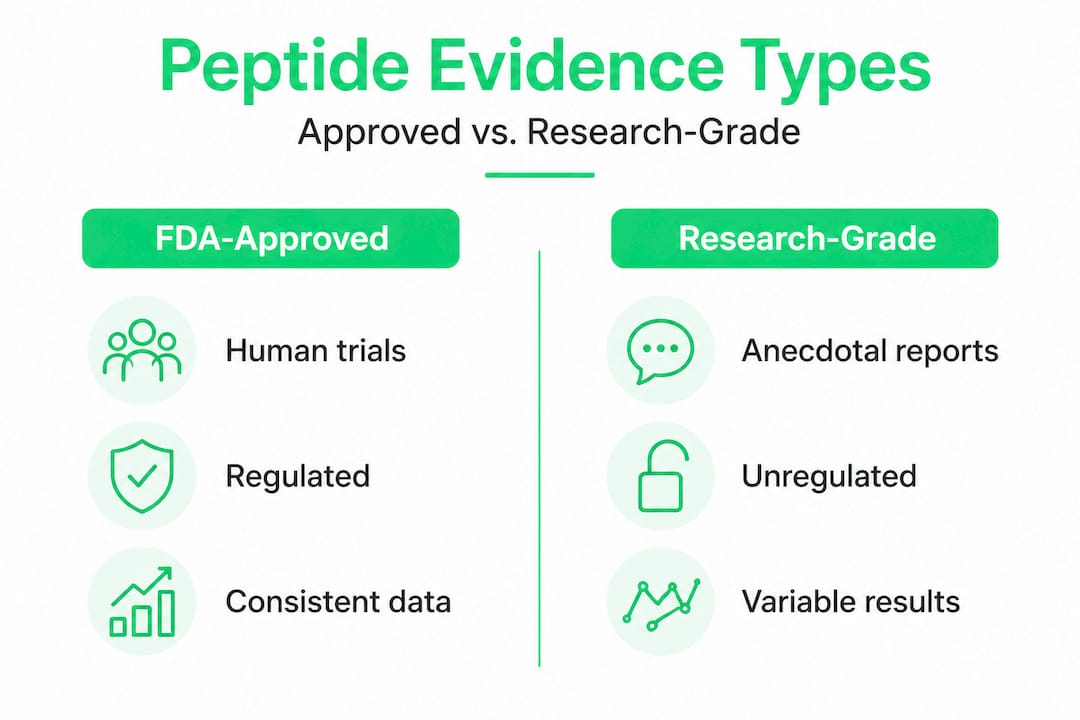
Consider GLP-1 receptor agonists like semaglutide. These peptides have been studied in large-scale randomized controlled trials involving thousands of patients, with clearly defined primary endpoints like HbA1c reduction and body weight loss, and long-term safety follow-up. The evidence is robust. When someone tells you semaglutide works, that claim is backed by phase III data, regulatory review, and post-market surveillance.
Now contrast that with many fitness and aesthetics-focused research peptides. Here's a straightforward breakdown of how evidence quality typically stacks up:
- Phase III randomized controlled trials: The gold standard; large sample sizes, control groups, blinded assessors, pre-registered endpoints. Examples include trials for approved GLP-1 agonists, growth hormone secretagogues with approved status, and certain healing peptides in regulated markets.
- Phase II trials: Smaller, but still controlled and randomized. Beginning to establish dose-response and efficacy signals in specific patient populations.
- Phase I trials: Primarily safety-focused with early efficacy signals. Often single-arm, meaning there's no comparison group, which limits what you can conclude about actual effects.
- Open-label or observational studies: No control group, no blinding. Useful for generating hypotheses but highly susceptible to placebo effect and reporting bias.
- Animal and in vitro data only: No human evidence. Promising mechanisms, but translation to humans is unproven.
"Many research peptides that are popular in fitness and biohacking communities have clinical evidence that sits at level 4 or 5 on this hierarchy. That doesn't mean they have no value, but it means you're operating with far more uncertainty than most vendors acknowledge."
When evaluating approved peptide drug evidence, always ask which rung of this ladder the supporting studies occupy. A peptide with only animal data and one small open-label human study is a fundamentally different risk proposition than one with multiple randomized controlled trials.
Be especially cautious about efficacy claims for compounded peptide products, which are mixed by pharmacy compounding facilities and sold outside the conventional drug approval pathway. These products may not have the same purity, potency, or sterility as approved medications, and the clinical evidence supporting their specific formulations is often nonexistent.
Interpreting nuanced evidence and trial designs
The hardest cases aren't the clear-cut ones. The hardest cases are the peptides sitting in a gray zone: they have some early human data, the mechanism is plausible, a few researchers are excited, and the community is buzzing. How do you interpret those signals without either dismissing them prematurely or over-investing in something unproven?
First, understand the difference between mechanistic plausibility and proven clinical efficacy. A peptide might have a beautifully rational mechanism. Maybe it upregulates a growth factor, or modulates an inflammatory cytokine pathway, or enhances mitochondrial function in muscle cells. That's genuinely interesting. But the human body is vastly more complex than those mechanisms suggest, and compensatory systems, off-target effects, and pharmacokinetic realities often neutralize what looks promising on paper.
Early human data exists for some peptides, but quality is highly variable and should be interpreted carefully. A Phase I trial, for example, is designed to assess safety and tolerability, with efficacy as a secondary exploratory endpoint. Finding a signal in that context is encouraging, but it's an invitation to do more research, not confirmation of efficacy.
Key questions to ask when interpreting any peptide efficacy claim:
- Was the study randomized and controlled, or open-label and single-arm?
- What was the primary endpoint, and was it clinically meaningful?
- What was the sample size, and was the study powered to detect the reported effects?
- Were the participants representative of you, in terms of age, health status, and goals?
- Was the dosing protocol similar to what you would actually use?
- Were adverse effects tracked systematically, and what was the safety profile?
Pro Tip: "Exploratory efficacy" in a clinical trial report is a specific term that signals the researchers were looking for signals, not testing a confirmed hypothesis. These findings are hypothesis-generating, not conclusive. Weight them accordingly.
The population question deserves extra attention. Many peptide studies use specific patient populations, such as people with diagnosed growth hormone deficiency, chronic wounds, or metabolic disease. Extrapolating those results to healthy adults seeking performance optimization is a significant logical leap that researchers themselves often caution against. Quality clinical trial evidence should reflect a population comparable to your own situation before you draw meaningful conclusions.
Practical wisdom: What most guides leave out about peptide efficacy
Here's the uncomfortable truth most peptide guides skip entirely: the majority of mistakes people make in peptide therapy don't come from choosing the wrong compound. They come from misjudging the quality of the evidence supporting that compound.
It's easy to find enthusiastic forum posts, compelling YouTube breakdowns, and vendor-sponsored "research summaries" that make any peptide sound like it has solid scientific backing. The reality is that FDA-approved therapies carry fundamentally clearer evidence and regulatory oversight compared to non-approved or compounded peptide products. That gap isn't a technicality. It's the difference between knowing something works and hoping it does.
The biohacking community often treats mechanistic plausibility as near-equivalent to proven efficacy, especially when animal data looks strong. But across nearly every class of therapeutic compound, the historical translation rate from animal studies to successful human trials is sobering. Peptides are not exempt from this pattern. A peptide that dramatically accelerates wound healing in rodents may face entirely different pharmacokinetic and immunological realities in humans.
There's also a seductive assumption that advanced delivery technologies automatically overcome biological barriers. Nanoparticle carriers, lipid encapsulation, and modified amino acid sequences are genuinely exciting tools, but they each require their own clinical validation. An innovative delivery system tested only in cells or rats is still an unproven system. Don't let technical sophistication substitute for human trial data.
The most evidence-driven approach is straightforward: prioritize peptides with approved regulatory status and multiple controlled trials when your health goals can be met with those options. Reserve research-grade peptides for situations where approved alternatives don't exist, you've carefully reviewed the available human data, and you're working with a knowledgeable clinician who can monitor your response. That's not being overly conservative. That's being smart.
Next steps: Find evidence-based peptide guidance
If reading through the layers of peptide evidence feels like a full-time job, that's because navigating it well genuinely requires real-time data synthesis and personalized context. Tracking your stack, adjusting dosing based on biometric feedback, and cross-referencing peer-reviewed research for every compound you consider is exactly where most people run into trouble.

Peptide AI is built specifically for this challenge. The app catalogs 50+ peptides including BPC-157, TB-500, and Semax, and pairs each one with peer-reviewed research so you're never flying blind. The AI Insights Chatbot delivers real-time, data-backed recommendations personalized to your protocol, while seamless integration with Apple Health, Oura Ring, and Whoop keeps your biometric feedback front and center. If you're serious about making evidence-driven decisions, the evidence-driven peptide AI platform gives you the tools to do it right, from protocol design through outcome tracking.
Frequently asked questions
What does peptide efficacy actually mean for fitness or health?
Peptide efficacy describes how reliably a peptide yields measurable benefits, scientifically assessed by target engagement and clinical results under real-world conditions, not just what it does in a test tube or animal model.
Why do some peptides work well in animal studies but fail in humans?
Most failures trace back to low bioavailability and rapid degradation combined with differences in human metabolism that animal models simply can't replicate.
Are FDA-approved peptide drugs always more effective than compounded or research-grade peptides?
FDA-approved peptides are backed by controlled human trial evidence, while research-grade or compounded products often lack the rigorous data needed to confirm real-world efficacy with confidence.
How can I tell if an efficacy claim is genuinely supported by strong evidence?
Look for results from randomized controlled trials with pre-specified endpoints; be cautious of claims based on open-label or single-arm studies, which can't establish causation the way controlled trials can.