
Most people hear "biomarkers" and think cancer screening or disease diagnosis. That's a reasonable assumption, but it misses something important. Peptide biomarkers are increasingly central to how serious biohackers, athletes, and peptide therapy users track whether their protocols are actually working, whether their bodies are adapting safely, and where to adjust next. If you're running a peptide stack without monitoring the relevant markers, you're essentially flying without instruments. This guide breaks down what peptide biomarkers are, how to use them practically, and how to avoid the most common mistakes.
Table of Contents
- What are peptide biomarkers?
- Types of peptide biomarkers and their functions
- Why peptide biomarkers matter for therapy, recovery, and performance
- Advanced insights: Detection limits, interpretation, and pitfalls
- Case examples: How peptide biomarkers change in therapy and recovery
- Expert perspective: What most people miss about peptide biomarkers
- How Peptide AI helps you harness peptide biomarkers smarter
- Frequently asked questions
Key Takeaways
| Point | Details |
|---|---|
| Peptide biomarkers defined | They are short protein fragments in body fluids that indicate biological states or therapy responses. |
| Track the right types | Diagnostic, prognostic, predictive, pharmacodynamic, and safety biomarkers each serve distinct monitoring roles. |
| Essential for therapy success | Key markers like IGF-1, GH, and collagen peptides drive safe, effective performance and recovery. |
| Awareness of limitations | Low abundance, detection limits, and contextual interpretation are crucial for accurate use. |
| Expert perspective matters | Informed, disciplined biomarker tracking outperforms trends or one-off measurements. |
What are peptide biomarkers?
Peptide biomarkers are small protein fragments made up of short chains of amino acids. They circulate in biological fluids like serum, plasma, and urine, and they're produced through proteolytic processes, meaning the body's natural protein breakdown machinery generates them continuously. What makes them useful is that they reflect what's happening inside cells and tissues in real time.
Unlike large protein biomarkers, peptides are small enough to remain stable during sample collection and processing. They also tend to have low immunogenicity, meaning they don't trigger strong immune reactions in the body, which keeps their presence more consistent and measurable. As noted in diagnostic medicine research, peptide biomarkers are particularly notable for their stability and their ability to reflect biological states and responses across a wide range of conditions.
Here's what makes peptide biomarkers stand out:
- Small size: Easier to detect in biological fluids, pass through filtration barriers, appear in urine as well as blood
- High stability: Less prone to degradation during lab handling than larger proteins
- Tissue specificity: Certain peptides are released only from specific tissues (e.g., collagen fragments from bone or muscle)
- Sensitivity to change: Shift measurably in response to therapy, inflammation, injury, or metabolic changes
- Low immunogenicity: Minimal immune interference means cleaner signal in testing
"Peptide biomarkers sit at the intersection of specificity and practicality. They tell you something real about your biology, and they're stable enough to measure reliably across different conditions and sample types."
Understanding peptide biomarker classifications in more depth helps you recognize which category of marker matters most for your specific goals, whether that's tissue repair, hormonal optimization, or safety monitoring.
Types of peptide biomarkers and their functions
Peptide biomarkers aren't a single category. They break down into five main types, each serving a distinct role. Understanding which type you're tracking helps you interpret results correctly and avoid conflating different signals.
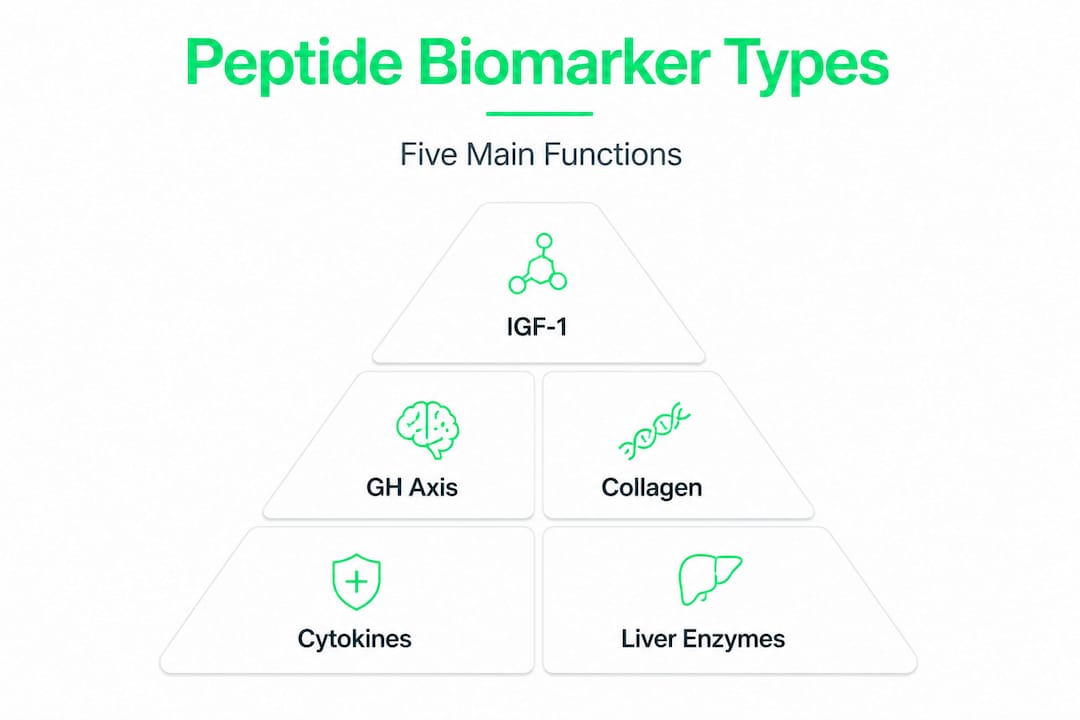
| Biomarker type | What it tells you | Common peptide examples |
|---|---|---|
| Diagnostic | Signals the presence of a condition | Apelin, BNP (heart failure), calcitonin |
| Prognostic | Predicts likely outcomes over time | NT-proBNP, certain collagen peptides |
| Predictive | Indicates likely response to a treatment | GH receptor expression markers |
| Pharmacodynamic | Confirms a therapy is producing the intended effect | IGF-1 rise after GH secretagogue use |
| Safety | Detects adverse effects early | ALT, AST, creatinine, CBC patterns |
Each type plays a different role in your protocol:
- Diagnostic markers tell you where you're starting from and whether a condition is present
- Prognostic markers help estimate trajectory, useful for long-term planning
- Predictive markers inform which peptides are likely to work based on your biology
- Pharmacodynamic markers are the core of therapy tracking, confirming that a peptide is actually doing what it's supposed to do in your body
- Safety markers catch problems before they become serious, particularly important for liver and kidney load during extended cycles
For example, when using growth hormone secretagogues like Ipamorelin or CJC-1295, IGF-1 is your primary pharmacodynamic marker. It confirms the peptide is stimulating GH production effectively. Without tracking this, you're guessing. Understanding peptide efficacy challenges helps explain why pharmacodynamic confirmation matters so much in practice, given how variable individual responses can be.
Why peptide biomarkers matter for therapy, recovery, and performance
Tracking biomarkers isn't just academic. It directly determines whether your therapy is working, whether your dose is appropriate, and whether your body is handling the intervention safely. Here's what the key markers actually tell you.

| Biomarker | What it measures | Optimal range (therapy context) |
|---|---|---|
| IGF-1 | GH axis response, anabolic signaling | 150-300 ng/mL (adult) |
| GH (fasting) | Direct GH output | Less than 5 ng/mL baseline |
| PINP | Bone formation and collagen synthesis | Context-dependent, look for increases |
| P3NP | Muscle collagen remodeling | Rises signal active repair |
| CTX | Bone resorption activity | Balanced with formation markers |
| IL-6 | Acute inflammation | Less than 3 pg/mL (resting) |
| hsCRP | Systemic low-grade inflammation | Less than 1 mg/L (optimal) |
| ALT/AST | Liver enzyme load | Within lab reference, trending stable |
| Fasting glucose | Metabolic safety with GH peptides | Less than 95 mg/dL |
As highlighted in therapeutic peptide monitoring research, IGF-1 and GH track efficacy for growth hormone secretagogues, collagen markers reflect tissue remodeling, cytokines indicate inflammation status, and liver enzymes confirm metabolic safety. These aren't optional extras. They're the instrument panel.
Here's a practical testing sequence to follow when running a peptide protocol:
- Establish a baseline before starting any peptide. This gives you a reference point that makes every future reading meaningful.
- Recheck at 6-8 weeks for GH-related peptides. IGF-1 is slow-moving enough that earlier checks often don't capture the full response.
- Monitor safety markers monthly during any extended protocol, particularly liver enzymes and fasting glucose.
- Track inflammatory markers like IL-6 and hsCRP if you're using peptides for injury recovery or anti-inflammatory effects, such as BPC-157 or TB-500.
- Adjust dosing based on data, not symptoms alone. Symptoms are lagging indicators. Biomarkers move earlier.
Pro Tip: If you're using peptides for performance and not tracking IGF-1 at minimum, you have no way to know if you're in a therapeutic range or just guessing. Tracking takes one blood draw every 6-8 weeks, which is a low effort for high-value data.
What happens when people skip monitoring? The risks go beyond inefficiency. Elevated IGF-1 sustained above 350 ng/mL has been associated with downstream concerns. Liver stress from peptide metabolism can develop silently. Inflammatory markers can shift without obvious symptoms. Safe and evidence-based peptide therapy consistently points toward proactive monitoring as the core of responsible use.
Advanced insights: Detection limits, interpretation, and pitfalls
Here's where most users fall short. Even people who track biomarkers often misinterpret what they're seeing, because peptide biomarker science has real technical limits that don't appear in popular summaries.
The first issue is detection. Many peptide biomarkers are present at very low concentrations in blood, sometimes in the femtomolar range. Detecting them reliably requires mass spectrometry (MS), a technique that's precise but not available in standard clinical labs. Most routine bloodwork uses immunoassays, which are faster and cheaper but less sensitive. This means some markers you read about in research papers aren't actually measurable with a standard lab panel, at least not yet.
"Peptide biomarkers are stable but short-lived in circulation. Detection often requires mass spectrometry due to their low abundance, and analytical validation is essential before clinical conclusions can be drawn."
The second issue is context. A single IGF-1 reading of 280 ng/mL doesn't tell you much on its own. Is it elevated from baseline? How long has it been there? What's your fasting glucose doing? An IGF-1 above 300 ng/mL combined with a fasting glucose rise of more than 15 mg/dL warrants attention. That combination signals both anabolic overdrive and metabolic stress, which changes the interpretation entirely.
The third issue is validation gaps. Not all peptide biomarkers used in the biohacking community have been validated in large-scale human trials. Many are based on preclinical animal studies or small observational datasets. This doesn't make them useless, but it means interpretation requires appropriate humility. Learning the foundations of peptide research helps you distinguish validated markers from speculative ones.
The top pitfalls to avoid:
- Relying on a single reading. One data point is noise. Two to three readings over time reveal a trend.
- Over-interpreting small changes. A 10% shift in IGF-1 within normal variance isn't a meaningful signal. Look for consistent directional movement.
- Skipping baseline measurements. Without a pre-protocol reading, you can't calculate change. All your subsequent data becomes context-free.
- Assuming lab values are universal. Reference ranges are population averages. Your optimal range may differ based on age, sex, training volume, and baseline health status.
Case examples: How peptide biomarkers change in therapy and recovery
Real data makes this concrete. Let's look at how peptide biomarkers actually shift in practice and what you can learn from these patterns.
Apelin is a peptide hormone that's emerged as a compelling marker for recovery contexts. Research on apelin in rehabilitation shows that levels change meaningfully with physical rehabilitation after stroke and in sarcopenia (age-related muscle loss). Elevated apelin correlates with improved muscle function and metabolic recovery, making it a candidate marker for tracking responses to peptides that target muscle repair, like TB-500 or BPC-157.
Serum peptide marker profiles also show precision for differentiating between similar conditions. The same research notes that peptide panels can screen for pancreatic cancer with high sensitivity and specificity, distinguishing it from pancreatitis. This kind of tissue-specific resolution is exactly what makes peptide biomarkers more actionable than generic inflammatory markers.
For a performance-focused tracking protocol using performance-enhancing peptides, here's what a realistic monitoring structure looks like:
- Week 0 (baseline): IGF-1, fasting GH, hsCRP, ALT/AST, fasting glucose, CBC
- Week 6-8: IGF-1 recheck, fasting glucose, liver enzymes
- Week 12: Full panel repeat including collagen markers (PINP, P3NP) if tissue repair is a goal
- Ongoing monthly: ALT/AST, fasting glucose, inflammatory markers if symptomatic changes occur
Key lessons from real-world biomarker tracking:
- Baselines are non-negotiable. Users who skip baseline testing consistently misinterpret their follow-up results.
- IGF-1 response varies widely. Some users see a 40% increase at 8 weeks; others see 15%. Both can be appropriate depending on starting point and peptide used.
- Collagen markers lag behind clinical improvements. You may feel better before PINP or P3NP shifts measurably. Don't expect instant biomarker confirmation.
- Inflammatory markers are early warning systems. Rising IL-6 or hsCRP during a protocol can signal your body is under stress before any symptoms appear.
- Glucose monitoring matters more than most users expect. GH secretagogues can impair insulin sensitivity transiently. Regular fasting glucose checks catch this early.
Expert perspective: What most people miss about peptide biomarkers
Here's the uncomfortable truth about how most people use biomarkers in the peptide and biohacking space: they treat them like scorecards instead of navigation tools.
A high IGF-1 reading after starting Ipamorelin feels like confirmation that the peptide is working. And it may be. But without knowing your baseline, without understanding whether that level is appropriate for your age and goals, and without tracking what else is moving alongside it, that number is mostly noise dressed up as signal.
There's also a real gap between what gets validated in research and what circulates in biohacking communities. As noted in clinical proteomics research, practitioners need to lean on established baselines and proven markers rather than chasing the latest speculative biomarker that appeared in a single small study. The gap between rigorous validation and practical biohacker use is wide, and most popular content glosses over it.
The most effective approach is disciplined minimalism. Rather than tracking a dozen markers and drowning in data, focus on a short list of validated, actionable markers: IGF-1 for GH peptide response, fasting glucose for metabolic safety, ALT/AST for liver load, and hsCRP or IL-6 for inflammation status. These four cover the majority of what you actually need to know for most protocols. Trusting safe and evidence-based peptide monitoring means resisting the temptation to add complexity when simplicity delivers better outcomes.
The other thing most people miss is that biomarkers tell a story over time, not at a moment. The trend matters far more than any single reading. If your IGF-1 is climbing steadily toward the upper end of range across three consecutive checks, that's a meaningful signal. If it spikes once and returns, that's likely noise. Patience and consistency with testing yields far more insight than frequent, anxious monitoring.
How Peptide AI helps you harness peptide biomarkers smarter
Understanding peptide biomarkers is one thing. Putting that knowledge into practice consistently is where most people lose momentum. Logging baseline labs, scheduling rechecks, interpreting trends across time, and adjusting protocols based on real data requires a system, not just information.
Peptide AI gives you exactly that. The app lets you log and track key biomarkers alongside your peptide stack, connecting your protocol data to your biometric readings in one place. With integration across Apple Health, Oura Ring, and Whoop, you can see how your markers align with sleep, HRV, and recovery scores over time. The AI Insights Chatbot provides data-backed peptide therapy guidance tailored to your actual numbers, not generic recommendations. Whether you're running BPC-157 for recovery or Ipamorelin for body composition, Peptide AI helps you make smarter decisions grounded in what your biomarkers are actually telling you.
Frequently asked questions
What are some common peptide biomarkers for performance or therapy?
IGF-1, GH, collagen markers (PINP, P3NP, CTX), cytokines like IL-6, and liver enzymes (ALT/AST) are the most commonly tracked markers for peptide therapy and performance optimization.
How often should you check peptide biomarkers in therapy?
Best practice is baseline testing before starting, then 6-8 week IGF-1 and safety checks for growth hormone peptides, with dose adjustments made based on those results.
Are peptide biomarkers only used in medical diagnosis?
No. While they're critical in disease contexts, peptide biomarkers also guide safe peptide therapy, athletic recovery protocols, and performance tracking for biohackers and fitness enthusiasts.
What is the benefit of using peptide biomarkers for fitness enthusiasts?
Tracking the right markers lets you optimize dosing, confirm real progress, and catch safety signals early, turning guesswork into a data-driven protocol.