
Most people searching for a telemedical peptide consulting app assume that somewhere out there, a single app exists that lets you chat with a licensed clinician, get a peptide prescription, and track your BPC-157 protocol all in one place. That assumption is wrong, and it's costing people time, money, and potentially their safety. Apps like PeptIQ are upfront about this: the PeptIQ App Store listing explicitly states it does not provide medical advice, diagnosis, or treatment. This guide maps out exactly what's available today, where the gaps are, and how to build a smart, safe peptide optimization approach with the tools that actually exist.
Table of Contents
- What is peptide therapy, and why is telemedicine important?
- What do telemedical peptide apps actually offer?
- The gap: what you can and can't do with peptide apps today
- How to safely approach peptide therapy with telemedical tools
- Why a true all-in-one telemedical peptide app doesn't exist yet
- Take the next step with AI-driven peptide management
- Frequently asked questions
Key Takeaways
| Point | Details |
|---|---|
| No true all-in-one app | No current app legitimately offers telemedical peptide prescription and consulting in one package. |
| Most apps are for education | Apps like PeptIQ provide tracking, education, and reminders but not medical consulting. |
| Safety comes first | Always consult a licensed provider before starting peptide therapy, even if an app suggests otherwise. |
| AI tools enhance tracking | AI-driven platforms can help personalize and optimize your peptide journey safely when used with expert guidance. |
What is peptide therapy, and why is telemedicine important?
Peptide therapy is the use of short chains of amino acids, called peptides, to signal specific biological processes in the body. Unlike conventional drugs, peptides often mimic or amplify natural signaling mechanisms. Common use cases include sports recovery, where peptides like BPC-157 and TB-500 support tissue repair and reduce inflammation; anti-aging protocols that target growth hormone secretion; and cognitive enhancement with nootropic peptides like Semax. The appeal is precision. You're not flooding your system with a broad pharmaceutical. You're sending a targeted signal.
Telemedicine, the practice of receiving medical consultation and care remotely through digital tools, appeals to peptide users for obvious reasons. Access is the biggest one. Many people pursuing peptide optimization live far from specialists who understand this space. Privacy matters too. A lot of users prefer not to have these conversations in a traditional clinical setting where providers may be unfamiliar or even dismissive. Speed is another driver. When you're managing a recovery protocol or a timed peptide cycle, waiting weeks for an in-person appointment isn't practical. The impact of telemedicine on healthcare access has been significant, especially for niche medical areas where local specialists are rare.
Here's the honest reality: most apps currently labeled as telemedical peptide platforms do not offer actual medical consulting. They track, they educate, and they remind. That's it. As the PeptIQ listing confirms, current peptide apps provide education and tracking but do not offer direct medical advice or treatment.
Key benefits users expect from a real telemedical peptide app:
- Licensed provider consultations within the app
- Personalized peptide protocol recommendations from a clinician
- Secure messaging with a healthcare professional
- Legal prescription fulfillment through a verified pharmacy
- Integrated biometric tracking tied to clinical oversight
- FDA-compliant documentation for prescribed peptides
Pro Tip: Before downloading any app marketed as a peptide solution, check the App Store description for explicit disclaimers. If it says anything close to "this is not medical advice," you're looking at an education and tracking tool, not a telemedical platform.
"PeptIQ does not provide medical advice, diagnosis, or treatment."
This kind of disclaimer is the industry norm right now, not the exception. Explore the Peptide AI app features to see how AI-powered platforms are navigating this landscape responsibly.
What do telemedical peptide apps actually offer?
Understanding what apps promise versus what they deliver requires breaking down the core functions separately. Let's look at what you'll actually find when you download one of these platforms.
Education is genuinely strong across many apps. You'll find information on peptide mechanisms, usage patterns, peer-reviewed research summaries, and community insights. Tracking is also a real capability. You can log doses, set injection reminders, and monitor your progress over time. Some apps include note fields for logging energy levels, sleep quality, or recovery metrics alongside your dosing history. These are genuinely useful functions.

What you won't find is clinical consulting. No app currently approved in major app stores allows a licensed physician to review your bloodwork inside the app and issue a peptide prescription. That workflow simply doesn't exist in mobile form yet. The PeptIQ listing is transparent: it is a peptide tracking and education tool, not a telehealth platform. This distinction matters enormously for anyone making decisions about their health.
Comparison: current app capabilities vs. what an all-in-one telemedical app would offer
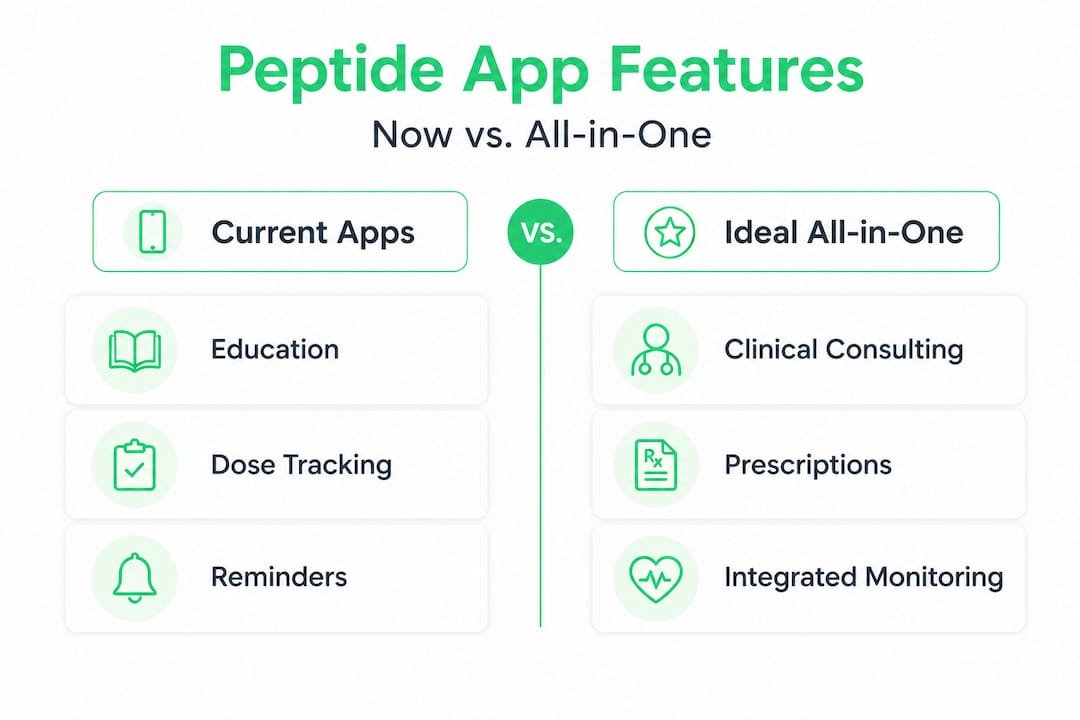
| Feature | PeptIQ (current) | Theoretical all-in-one app |
|---|---|---|
| Peptide education library | Yes | Yes |
| Dose logging and reminders | Yes | Yes |
| AI-powered personalization | Limited | Full |
| Licensed clinician chat | No | Yes |
| Blood panel review | No | Yes |
| Prescription fulfillment | No | Yes |
| FDA-compliant prescribing | No | Yes |
| Wearable data integration | Limited | Full |
The gap between column two and column three is significant. For anyone serious about optimizing with peptides, understanding this gap is the first step to building a realistic plan.
Steps most users take when seeking peptide therapy online:
- Research peptides using available apps and scientific literature
- Identify a reputable telehealth clinic that specializes in peptide therapy
- Complete a health assessment or intake form with the clinic
- Schedule a synchronous or asynchronous consultation with a licensed provider
- Receive a protocol recommendation and, if appropriate, a prescription
- Use a tracking app to log progress and flag any side effects
- Schedule follow-up consultations to adjust the protocol based on data
Notice that steps four and five happen outside of any current mobile app. The teleconsultation guides available for healthcare providers confirm that real teleconsultation requires structured clinical workflows, not just a chat function bolted onto a tracking app.
Pro Tip: If an app claims to offer peptide consulting but doesn't clearly list licensed providers, a regulated prescription process, or state-by-state compliance information, treat it as an education tool only. This isn't pessimism. It's how you protect yourself.
When identifying mobile applications in healthcare, the distinction between health information tools and clinical platforms matters legally and practically.
The gap: what you can and can't do with peptide apps today
Let's be specific about what the current app landscape provides and where it stops. This clarity helps you plan your approach without wasting time chasing features that don't exist.
Current availability of peptide app features:
| Feature | Available | Limited | Not available |
|---|---|---|---|
| Dose tracking | Yes | ||
| Peptide education | Yes | ||
| Injection reminders | Yes | ||
| Protocol templates | Limited | ||
| Biometric integration | Limited | ||
| AI-driven recommendations | Limited | ||
| Clinician chat | Not available | ||
| Prescription fulfillment | Not available | ||
| Lab result review | Not available | ||
| FDA-compliant prescribing | Not available |
Currently, zero major mobile apps offer certified telemedical peptide prescribing. That's not a gap waiting to be filled by the next update. It reflects a structural reality about how medical prescribing works in regulated healthcare environments.
Features you cannot access in any current peptide app:
- Direct messaging with a licensed physician who can prescribe
- Legally compliant peptide prescriptions issued through the app
- Integration with a certified compounding pharmacy for fulfillment
- Real-time clinical oversight of your biometric data
- Truly personalized AI wellness plans based on lab results and clinician input
Why does this limitation exist? The answer comes down to three forces working together: regulatory requirements, patient safety standards, and legal liability. In the US, prescribing controlled or regulated compounds requires a licensed provider to establish a valid patient-provider relationship, typically through a documented clinical encounter. App stores and healthcare regulators have not yet created a clear framework for embedding that relationship inside a consumer mobile app. As PeptIQ's listing confirms, apps that log, track, and educate explicitly avoid prescriptions, clinical consulting, or personalized medical advice for exactly these reasons.
The benefits and limits of telemedicine in clinical practice illustrate this well. Telemedicine is powerful but it still requires the same professional standards as in-person care. An app interface doesn't change that requirement.
Explore AI-powered solutions for peptide therapy to understand what's technically feasible within these constraints and where innovation is heading.
How to safely approach peptide therapy with telemedical tools
If you're committed to using digital tools as part of your peptide optimization journey, here's a practical, safety-first roadmap that actually works within the current regulatory environment.
Step-by-step safe approach to peptide therapy:
- Start with education. Use a quality peptide tracking app to learn about peptides that match your goals. Understand mechanisms, typical dosing ranges, and known side effects before going further.
- Find a licensed provider. Search for telehealth clinics that specialize in peptide therapy or functional medicine. Look for board-certified physicians, nurse practitioners, or other licensed providers who have documented experience with peptide protocols.
- Complete a thorough health assessment. Any reputable provider will want baseline bloodwork and a full health history before recommending a peptide protocol. This is non-negotiable.
- Receive and review your personalized protocol. Once a provider has reviewed your labs and health profile, they can recommend specific peptides, dosing schedules, and administration methods.
- Use a tracking app to log your progress. This is where apps genuinely shine. Log every dose, record observations about energy, recovery, sleep, or any side effects. Bring this data to your follow-up consultations.
- Schedule regular follow-ups. Peptide protocols often need adjusting. Regular check-ins with your provider, supported by your tracking data, make those adjustments much safer and more effective.
As PeptIQ confirms, apps in this space offer education, tracking, and reminders, but users must consult licensed clinicians for actual peptide therapy. That structure, app for tracking and clinician for prescribing, is the responsible model for 2026.
The online doctor teleconsultation landscape has matured significantly. Finding a legitimate telehealth provider for peptide therapy is more accessible now than it was three years ago. The tools exist. You just need to know how to combine them.
Pro Tip: Before sharing your health data with any app or provider, verify their privacy practices. Look for HIPAA compliance statements from providers and review app privacy policies for data sharing clauses.
"Any meaningful peptide therapy protocol starts with a licensed medical consultation. No app, AI, or online community is a substitute for that clinical relationship."
Tools like AI-driven peptide management can make the tracking and education side of this equation significantly more powerful, especially when paired with a solid clinical foundation.
Why a true all-in-one telemedical peptide app doesn't exist yet
Here's an opinion worth sitting with: the demand for an all-in-one telemedical peptide app is real and growing, but the forces blocking its creation are also real. They're not arbitrary obstacles.
Regulatory frameworks for prescribing in the US were built around in-person clinical relationships. Extending those frameworks to include AI-powered, app-based prescribing for compounds like peptides (many of which sit in a legal gray zone between research chemicals and regulated pharmaceuticals) is genuinely complex. This isn't bureaucratic foot-dragging. It's a reflection of how long it takes regulatory bodies to evaluate new care delivery models safely.
Ethical barriers add another layer. An app that could prescribe peptides without adequate clinical oversight would almost certainly be misused. The same consumer enthusiasm that drives innovation also creates pressure to move faster than safety standards should allow. Any developer building a true telemedical peptide platform has to answer hard questions about liability, informed consent, and follow-up care in ways that current tracking apps simply don't.
Technology is closer to being ready than regulation is. AI models can already synthesize complex biometric data and generate protocol recommendations that rival what many generalists could produce. But an AI recommendation and a licensed prescription are categorically different things. Apps like PeptIQ are transparent about not being substitutes for medical care, and that honesty reflects where the technology is legally permitted to operate.
What's likely to change? The future of AI in peptide therapy points toward tighter integration between AI platforms and licensed clinical networks. Expect to see more partnerships between tracking apps and telehealth providers, creating hybrid workflows where the app handles data and the clinician handles decisions. That model is already emerging in adjacent areas of digital health. It's coming to peptides.
What you can do now: stay informed, advocate for science-based regulation, and use the tools available to you as well as possible while the regulatory environment catches up to the technology.
Take the next step with AI-driven peptide management
If you've made it this far, you're serious about optimizing your biology the right way. The honest truth is that no single app replaces a licensed clinician, but the right platform can make every other part of your peptide journey significantly more effective.
Peptide AI is built specifically for people who think this way. It catalogs 50+ peptides including BPC-157, TB-500, and Semax, supports custom stack building with precise dosing schedules, and integrates with Apple Health, Oura Ring, and Whoop for real biometric context. The AI Insights Chatbot delivers data-backed guidance grounded in peer-reviewed research, while the AI Body Scanner tracks physical changes over time. This is the foundation layer: intelligent, research-grade peptide management that puts you in the best possible position before, during, and after working with a licensed provider.
Frequently asked questions
Can I get peptides prescribed directly from a mobile app?
No major app currently prescribes peptides. As PeptIQ's listing confirms, these platforms do not provide medical advice, diagnosis, or treatment. You need a licensed medical provider for any prescription.
What features should I look for in a peptide therapy app?
Prioritize education libraries, dose logging, protocol tracking, and wearable integration. Then separately confirm whether the platform connects you with a licensed clinician for actual consulting, since most apps do not.
Why don't apps offer full peptide consulting and prescriptions?
Legal and patient safety rules require a valid patient-provider relationship before any prescription can be issued. As confirmed by PeptIQ's disclaimer, apps that don't offer treatment or medical advice are responding to these regulatory realities, not avoiding innovation.
Are AI-driven apps safe for self-managing peptide therapy?
AI tools are excellent for education, pattern recognition, and tracking reminders, but apps like PeptIQ explicitly state they are not substitutes for medical advice. Always consult a licensed provider before starting any peptide protocol.