
Peptide therapy is everywhere right now — from biohacker forums to longevity clinics — yet the gap between what's being claimed and what science actually supports has never been wider. Amino acid chains that act as biological messengers, peptides can influence everything from tissue repair to hormone secretion, which explains the excitement. But most people stepping into this space don't realize that the majority of fitness-focused peptides have never been tested in controlled human trials, and several have been flagged as unsafe for general use. This guide cuts through the noise with a clear, evidence-first look at what peptide therapy can and cannot do.
Table of Contents
- What is peptide therapy? Definitions and key concepts
- The science: What research shows about peptide benefits and limitations
- Safety, regulation, and risks: What you need to know
- How to personalize and optimize peptide therapy protocols
- A practitioner's perspective: Peptide therapy's real value and hype demystified
- Ready to optimize your peptide therapy? Your next step
- Frequently asked questions
Key Takeaways
| Point | Details |
|---|---|
| Definition clarified | Peptide therapy uses short-chain amino acid molecules to target fitness, recovery, or longevity, but effectiveness varies widely. |
| Evidence overview | Most benefits are based on preclinical findings with limited strong human data supporting popular fitness peptides. |
| Major risks | Unapproved peptides carry risks of contamination, labeling issues, and serious health effects, requiring clinical oversight. |
| Safe protocol strategy | The safest results come from medical supervision, personalized planning, and integrating peptides with healthy lifestyle habits. |
What is peptide therapy? Definitions and key concepts
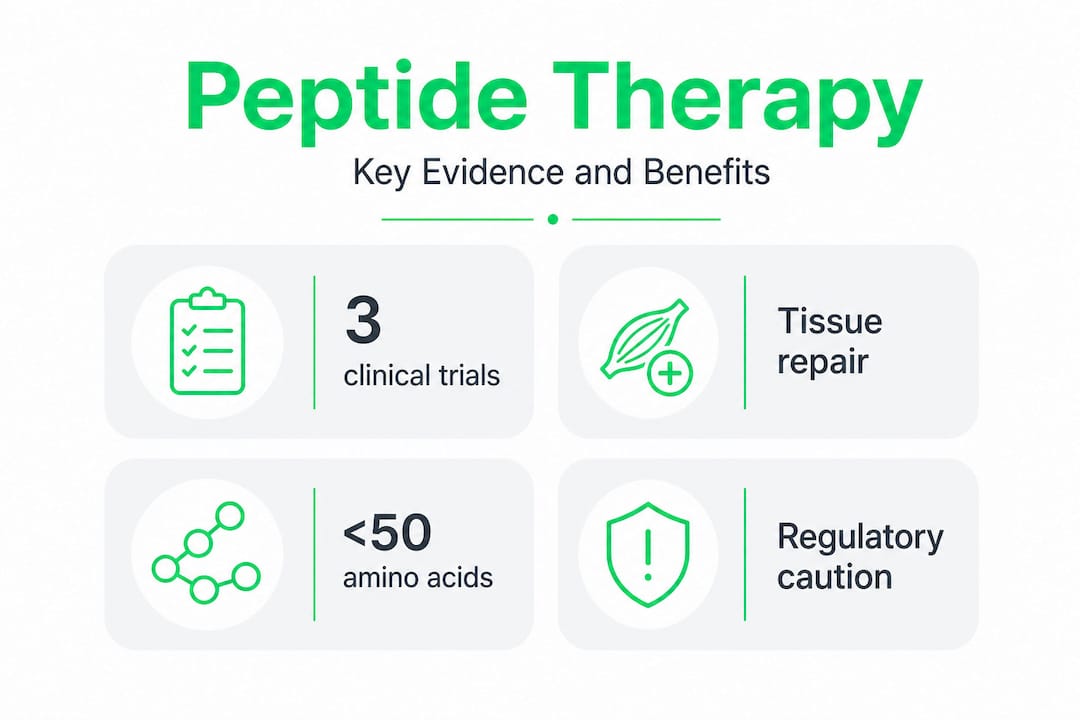
Peptides are short chains of amino acids, typically between 2 and 50 residues long, that act as signaling molecules in the body. Think of them as highly specific biological keys that fit into specific cellular locks, triggering targeted responses like collagen production, hormone release, or inflammation control. Unlike full proteins, peptides are small enough to interact directly with cell surface receptors without needing to be broken down first.
Peptide therapy involves using these molecules, either naturally derived or synthetically produced, to amplify or restore biological functions that may be declining due to age, injury, or stress. The appeal is obvious: instead of flooding your system with broad hormones like testosterone or HGH (human growth hormone), you're theoretically sending precise signals to targeted tissues.
The peptides generating the most attention in fitness and recovery circles include several popular compounds worth understanding:
- BPC-157 (Body Protection Compound 157): Promoted for tissue repair, tendon healing, and gut lining restoration
- TB-500 (Thymosin Beta-4): Used for its claimed angiogenesis (new blood vessel formation) and muscle repair effects
- CJC-1295 combined with Ipamorelin: A growth hormone releasing combination stack favored for lean body composition and recovery speed
- Semax: A neuropeptide explored for cognitive enhancement and neuroprotection
- Epithalon: Associated with telomere lengthening and longevity claims
Understanding peptide classifications is critical before you choose any of these compounds, because the category a peptide belongs to directly determines its safety profile, legal status, and research backing.
"The enthusiasm around peptide therapy often outpaces the clinical evidence. While these molecules have fascinating biological properties, most of what we know comes from animal studies, not rigorous human trials." — Functional medicine practitioners and researchers consistently echo this warning when discussing the current state of peptide science.
The misconception that stops most people from doing proper due diligence is assuming that peptides are somehow semi-approved, or that their wide commercial availability means they've passed some form of safety review. They haven't. Widespread availability on research chemical sites does not equal regulatory approval or proven safety.
The science: What research shows about peptide benefits and limitations
Here's where things get genuinely complicated, and where honesty matters most. The science on peptides is real, but the majority of it has been conducted in rodent models or in vitro (cell culture) settings. Translating those results to human physiology is not automatic, and assuming it is has led to a lot of overpromised outcomes.

Preclinical studies consistently show compelling effects: BPC-157 accelerates tendon and ligament healing in rats, TB-500 promotes angiogenesis and reduces cardiac damage in animal models, and growth hormone secretagogues reliably increase IGF-1 (insulin-like growth factor 1) in both animals and humans. The human data, however, is thin across the board.
| Peptide | Primary claimed effect | Preclinical evidence | Human RCT evidence |
|---|---|---|---|
| BPC-157 | Tissue repair, gut healing | Strong (rodent studies) | None published |
| TB-500 | Angiogenesis, muscle repair | Moderate (animal models) | None published |
| CJC-1295/Ipamorelin | GH/IGF-1 increase | Strong | Limited (small trials) |
| Semax | Cognitive enhancement | Moderate | Minimal (Russian studies) |
| Epithalon | Telomere lengthening | Preliminary | Anecdotal only |
The absence of randomized controlled trials (RCTs) for most of these compounds is not a minor detail. RCTs are the gold standard for determining whether an intervention actually works and is safe at human doses. Without them, you're relying on animal data, anecdotal reports, and enthusiast-driven case studies — none of which can definitively prove efficacy or exclude harm.
A useful summary of peptide studies shows that even the most promising compounds like CJC-1295, which has more human trial data than most fitness peptides, still lack the long-term safety data you'd want before committing to regular use.
Pro Tip: When evaluating any peptide research claim, look for the study population. If every citation points to rats or cell cultures with no human replication, treat the claim as preliminary and not yet actionable at clinical dosing.
The honest framing is this: peptides are biologically active and show genuine mechanistic promise. The question isn't whether they do anything — they clearly do something. The question is whether what they do in controlled lab conditions translates to meaningful, safe human outcomes at the doses being used outside of clinical supervision.
Safety, regulation, and risks: What you need to know
This is the section most peptide enthusiasts skip, and it's the most important one. The regulatory status of peptides varies significantly, and the gap between FDA-approved peptides and the ones circulating in fitness communities is enormous.
FDA-approved peptides have undergone rigorous clinical trials demonstrating both safety and efficacy. Peptides like semaglutide (used in Ozempic) and tesamorelin (approved for HIV-related lipodystrophy) are legitimate pharmaceutical products. Most fitness-focused peptides, however, are classified under a different framework entirely, often labeled Category 2 compounds that are explicitly prohibited from compounding due to identified safety concerns.
| Factor | FDA-approved peptides | Unapproved fitness peptides |
|---|---|---|
| Safety data | Extensive clinical trials | Mostly preclinical only |
| Oversight | Regulated by FDA | None or minimal |
| Legal status | Prescription only, legal | Gray area to illegal |
| Purity guarantee | Pharmaceutical grade | Not guaranteed |
| Dosing guidance | Evidence-based | Community-derived |
The risks of using unregulated peptides are concrete, not theoretical. Key documented risks include:
- Contamination and mislabeling: Independent lab testing of research-grade peptides regularly finds incorrect dosing, wrong compounds, or bacterial contamination
- Cancer promotion: Some peptides, particularly those that stimulate growth factors like IGF-1, may accelerate tumor growth in individuals with undetected malignancies
- Insulin resistance: Chronic use of growth hormone secretagogues can blunt insulin sensitivity over time
- Injection site problems: Nodules, infections, and sterile abscesses are common with improper reconstitution or injection technique
- Unknown long-term effects: No compound with only 2 to 5 years of community use data can be considered well-characterized for long-term safety
Pro Tip: Before sourcing any peptide, verify its current regulatory classification and insist on a certificate of analysis (COA) from an independent third-party lab. Medical oversight is not optional when navigating FDA-approved vs unapproved peptides — it's the single biggest risk mitigator available to you.
The compounding pharmacy issue is particularly important to understand. Before 2024, certain peptides like BPC-157 were available through compounding pharmacies with a prescription. Regulatory changes reclassified many of these as Category 2, which means they can no longer be legally compounded or dispensed in the U.S. If someone is selling you compounded BPC-157 today, you should ask serious questions about the legality and quality of what you're getting.
How to personalize and optimize peptide therapy protocols
Assuming you've done your regulatory and safety homework, the next question is how to actually design a protocol that works. The trap most people fall into is copying someone else's stack from an online forum without accounting for their own physiology, health history, or goals.
Here is a structured approach to personalizing a peptide protocol responsibly:
- Complete a clinical evaluation: Work with a physician who understands peptide therapy. Disclose all medications, supplements, and health conditions. Pay special attention to any personal or family history of cancer.
- Run baseline labs: At minimum, get a comprehensive metabolic panel, fasting insulin, IGF-1, CBC (complete blood count), and any hormone panels relevant to your goals. These labs establish your starting point and let you detect changes over time.
- Design a conservative dosing strategy: Start low and monitor your response before escalating. Most adverse effects come from people who start at community-recommended doses rather than titrating up from a minimal effective dose.
- Build in a monitoring schedule: Repeat your labs every 8 to 12 weeks. Track subjective markers like sleep quality, energy, body composition, and recovery speed. This data tells you whether the protocol is working and catches early warning signs.
- Cycle your peptides: Continuous use without cycling can lead to receptor desensitization and reduced efficacy. Most practitioners recommend on/off cycles such as 8 weeks on, 4 weeks off, though this varies by compound.
There are specific situations where peptide therapy should be avoided regardless of your goals:
- Active or suspected cancer or malignancy of any kind
- Pregnancy or breastfeeding
- Sourcing from unverified or non-clinical channels
- No access to medical oversight or lab monitoring
- Uncontrolled metabolic disorders like type 2 diabetes with poor glycemic control
Pro Tip: Lifestyle factors are not optional add-ons to peptide therapy. Sleep quality, resistance training, and protein intake directly influence how effectively peptides like BPC-157 support tissue repair and how efficiently growth hormone secretagogues work. A poor lifestyle doesn't just reduce peptide benefits — it can amplify risks by stressing already compromised physiology.
The integration of consistent resistance training, 7 to 9 hours of quality sleep, and adequate dietary protein (1.6 to 2.2 grams per kilogram of body weight) creates the biological environment where peptide signaling is most likely to produce the outcomes you're targeting. Peptides work best when you give them something to work with.
A practitioner's perspective: Peptide therapy's real value and hype demystified
Here's what clinical reality looks like that you won't find on most peptide forums: the biggest gains most people attribute to peptide use are actually driven by the comprehensive protocol changes they make at the same time. Better sleep, structured training, nutrition dialing, and consistent lab monitoring all improve outcomes dramatically, independent of which peptide is in the stack.
That's not to say peptides do nothing. Proponents highlight targeted efficacy, and there are genuine mechanisms at play. But skeptics, including the AMA, consistently point to regulatory gaps and the near-complete absence of controlled human safety data. Both perspectives are right, and sitting uncomfortably between them is where honest clinical practice lives.
The "just add the new peptide" mentality is the most common and most expensive mistake in this space. Someone using four compounds simultaneously who gets better has no idea which one drove the improvement, whether the combination was safe, or whether they would have improved equally without any of them. That's not optimization. That's noise.
What actually works is understanding peptide classifications deeply enough to select one or two well-researched compounds for a specific, measurable goal, run a clean protocol with proper lab monitoring, and build from there. The people getting real, sustained results from peptide therapy are almost always the ones treating it like a structured clinical intervention rather than a supplement stack.
Skepticism, in this context, isn't pessimism. It's the most effective tool you have for staying safe while still extracting genuine value from a genuinely promising field.
Ready to optimize your peptide therapy? Your next step
If this guide clarified anything, it's that peptide therapy done right requires data, structure, and ongoing feedback. Guessing on dosing or cycling based on forum posts is exactly the kind of approach that leads to wasted money and real health risks.

The Peptide AI platform was built specifically for people who want to move beyond guesswork. It catalogs over 50 peptides with peer-reviewed research backing, lets you build and track custom stacks with precise dosing schedules, and connects your protocol data with wearables like Apple Health, Oura Ring, and Whoop. The AI Insights Chatbot gives you real-time, data-backed recommendations, and the AI Body Scanner tracks physical transformation over time so your results are measurable, not anecdotal. Whether you're starting your first protocol or refining an existing stack, Peptide AI gives you research-grade intelligence built for serious users.
Frequently asked questions
What are the most popular peptides for fitness and recovery?
BPC-157, TB-500, and CJC-1295/Ipamorelin are among the most widely used, valued for tissue repair, angiogenesis, and growth hormone stimulation respectively. Each has a distinct mechanism and risk profile worth understanding before use.
Are peptides like BPC-157 and TB-500 FDA-approved?
No. Many fitness-focused peptides are not FDA-approved and are classified as Category 2 compounds, which prohibits them from being legally compounded or dispensed in the U.S.
What are the main risks of unregulated peptide use?
The primary risks include contamination, mislabeling, potential cancer promotion via IGF-1, insulin resistance from chronic secretagogue use, and injection site complications from improper preparation technique.
How can someone optimize their peptide therapy?
Start with a clinical evaluation and baseline labs, use a conservative dosing approach, and combine with diet, training, and sleep while monitoring biomarkers regularly under medical supervision. Cycling protocols and repeat lab testing are non-negotiable for safe long-term use.