
Most people enter the peptide space thinking it's simple: find a peptide that targets your goal, dose it, track results. The reality is far messier. Not every peptide marketed for performance, recovery, or longevity has the same quality of evidence behind it, and assuming they do is one of the most common mistakes serious optimizers make. Therapeutic peptides are medications made from short sequences of amino acids that modulate specific biological processes, but the word "therapeutic" covers enormous ground, from FDA-approved drugs with robust clinical data to gray-market compounds with almost no human studies. This guide breaks down what therapeutic peptides actually are, how they work, their real limitations, and how to think critically about the evidence before you ever load a syringe.
Table of Contents
- What are therapeutic peptides?
- How therapeutic peptides work: Mechanisms and formulation hurdles
- Engineering better peptides: Overcoming limitations
- Evidence and examples: What does the data actually say?
- The reality behind peptide therapy: Optimizing safely and smartly
- Ready to personalize your peptide journey?
- Frequently asked questions
Key Takeaways
| Point | Details |
|---|---|
| Short, specific molecules | Therapeutic peptides are short amino acid chains designed for precise biological effects. |
| Bioavailability challenges | Most peptides are unstable when taken orally, so injections are often necessary for effectiveness. |
| Engineered for improvement | Scientists modify peptides to boost their stability, duration, and cellular uptake. |
| Evidence varies widely | Not all peptides are equally proven; safety and results depend on peptide type and available data. |
| Personalization is key | Smart peptide therapy means personalizing choices and focusing on data-driven, reputable sources. |
What are therapeutic peptides?
Let's start with terminology, because the vocabulary matters here. A peptide is a short chain of amino acids linked by peptide bonds. Oligopeptides contain fewer than roughly 20 amino acids, while polypeptides can stretch to 50 or more before crossing into protein territory. For a clear breakdown of defining peptide terms, the distinctions matter practically, not just academically, since chain length directly affects how a molecule behaves in the body.
Peptides can be naturally occurring, meaning your body already synthesizes them as signaling molecules, or synthetic, meaning they're manufactured in a lab to mimic, amplify, or modify those natural signals. The difference between naturally occurring and synthetic peptides is less about safety and more about specificity and stability, which we'll cover in detail shortly.
How do they actually interact with your body? Therapeutic peptides typically work by binding to specific cellular targets, often surface receptors, and triggering downstream signaling cascades. Think of a receptor like a keyhole and the peptide as a precisely cut key. When the right peptide binds, it can switch a pathway on or off, modulate hormone secretion, stimulate tissue repair, or dampen immune overactivation. Understanding peptide classifications helps you map which peptide families target which systems, from growth hormone secretagogues to antimicrobial peptides to immunomodulators.
Key features that define therapeutic peptides:
- Short amino acid chains (typically 2 to 50 residues) that allow precise receptor targeting
- High biological specificity, meaning they act on defined pathways rather than broad physiological systems
- Ability to modulate signaling without permanently altering gene expression in most cases
- Relatively low toxicity compared to many small-molecule drugs, largely because of their structural similarity to endogenous molecules
- Variable stability depending on whether they're natural or chemically modified
Therapeutic peptides can trigger specific downstream pathways with a precision that most small-molecule drugs simply cannot match. That specificity is exactly why they're exciting and exactly why you can't generalize across the entire class. A peptide that excels at immune modulation tells you nothing about how a tissue-repair peptide will behave in your protocol.
How therapeutic peptides work: Mechanisms and formulation hurdles
Understanding what therapeutic peptides are naturally leads to the next critical question: how do these molecules actually work in practice, and what challenges do they face?

Peptide drugs primarily work by mimicking or modulating biological signaling. They bind to receptors, ion channels, or enzymes with high affinity, activating or blocking specific responses. The advantage here is real: that high specificity and targeted biological action means fewer off-target effects compared to broad-spectrum drugs. When BPC-157 is studied for gut repair, for example, it's acting on specific growth factor pathways rather than suppressing inflammation system-wide.
But here's where the biology gets inconvenient. Peptide therapies face serious bioavailability challenges due to enzymatic degradation, poor membrane permeability, and rapid renal clearance. Your digestive tract is designed to break down proteins and peptides into individual amino acids. That's its job. So when you swallow a peptide, proteolytic enzymes in your gut and liver often destroy the molecule before any meaningful amount reaches systemic circulation. This is why most research-grade peptides are administered via subcutaneous injection rather than oral consumption.
Administration route comparison:
| Route | Bioavailability | Advantages | Disadvantages |
|---|---|---|---|
| Subcutaneous injection | High (often 80%+) | Reliable absorption, predictable kinetics | Requires injection, localized reactions possible |
| Intravenous | Near 100% | Fastest onset, precise dosing | Requires clinical setting, highest infection risk |
| Intranasal | Moderate (varies widely) | Non-invasive, bypasses gut | Inconsistent absorption, peptide-specific |
| Oral | Very low (often under 5%) | Convenient | Enzymatic degradation destroys most peptides |
| Topical | Local only | Targeted to skin/wound site | Minimal systemic uptake by design |
Half-life is the other major problem. Many peptides are cleared from the bloodstream within minutes to a few hours, meaning even a well-absorbed dose may not have time to produce sustained effects. Formulation science exists specifically to address these problems, and the route you choose for a given peptide should match both the peptide's chemistry and your therapeutic goal.
Pro Tip: Don't assume a peptide is ineffective just because one administration route failed. Semax, for example, shows meaningful bioavailability via intranasal delivery but would be largely wasted if taken orally. Match your delivery method to the evidence for that specific compound.
Engineering better peptides: Overcoming limitations
Even with targeted action, peptide drugs have downsides. Scientists and clinicians routinely engineer solutions, and here's how those changes matter for you.
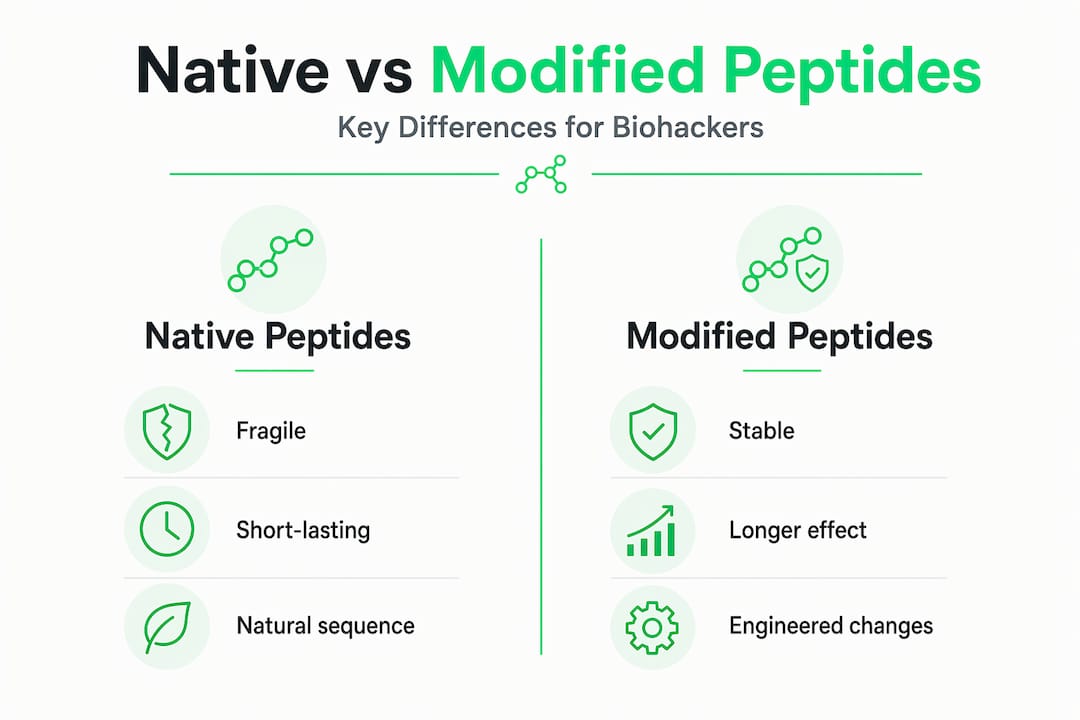
The core problem is that natural peptides, while biologically relevant, are often fragile. They can be broken down by proteases, cleared by the kidneys almost immediately, or rendered inactive by changes in pH or temperature. Therapeutic peptides are routinely engineered with chemical strategies to improve stability, pharmacokinetics, and cellular uptake. These aren't shortcuts or compromises. They're often what makes a peptide clinically viable.
Salt sensitivity and rapid clearance are the two biggest engineering targets. If a peptide's charged side chains interact too aggressively with salts in biological fluids, its conformation changes and it loses receptor-binding ability. If it clears too fast, you'd need constant dosing to maintain any effect.
Common engineering strategies and their benefits:
- Cyclization: Creates a ring structure that resists enzymatic attack, dramatically improving stability and often receptor selectivity
- PEGylation: Attaches polyethylene glycol chains to the peptide, increasing molecular size to slow renal clearance and extend half-life
- Lipidation: Adds fatty acid groups so the peptide can bind to albumin in blood, extending its circulation time (this is how semaglutide, a GLP-1 receptor agonist, achieves its once-weekly dosing)
- D-amino acid substitution: Swapping natural L-amino acids for their mirror-image D-forms makes the peptide unrecognizable to most proteases
- Stapling: Uses chemical crosslinks to lock the peptide in a specific shape, often improving both stability and target binding
Understanding synthetic peptide uses gives you the full picture of why engineered peptides aren't inherently less legitimate than "natural" ones. In many cases, an engineered analog outperforms the original molecule in every relevant clinical metric.
Pro Tip: When evaluating a peptide's potential, look at whether you're working with a native sequence or a modified analog. Modifications aren't red flags. Their absence in a compound claiming exceptional potency might be.
Evidence and examples: What does the data actually say?
Understanding how peptides are engineered is only part of the story. What really matters is the strength of evidence behind peptide therapies you may be considering.
The honest answer is that the evidence spectrum is enormous. Some peptide drugs are well-established pharmaceuticals with decades of clinical use and robust safety data. GLP-1 receptor agonists like semaglutide, oxytocin analogs, and tetracosactide (a synthetic ACTH analog) are all peptide-based medicines with extensive human evidence. But the peptides most often discussed in biohacking communities, BPC-157, TB-500, Epithalon, and others, sit in a very different category, one with promising preclinical data but limited or no controlled human trials.
Consider TCP-25, a topical peptide studied for wound healing and infection. In early clinical work, wound size reduction reached 76% median improvement with no meaningful systemic uptake detected. That's a meaningful result in a controlled context. But it also illustrates something important: that peptide worked in a specific application, topically, for a specific condition, without systemic exposure. You cannot extrapolate from that data to assume any other peptide will behave similarly or that systemic peptide use carries the same safety profile.
Comparing evidence tiers in peptide therapy:
| Peptide or class | Evidence level | Regulatory status | Primary use case |
|---|---|---|---|
| Semaglutide (GLP-1 agonist) | High (multiple large RCTs) | FDA-approved | Weight loss, type 2 diabetes |
| TCP-25 | Moderate (early clinical trials) | Investigational | Wound healing |
| BPC-157 | Low (animal studies, no RCTs) | Not approved | Recovery, gut repair |
| TB-500 | Very low (animal only) | Not approved | Tissue regeneration |
| Epithalon | Very low (limited human data) | Not approved | Longevity, telomere support |
How to evaluate any peptide claim before acting on it:
- Look for peer-reviewed human clinical trials, not just animal studies or anecdotal reports
- Check the regulatory status of the compound in your jurisdiction
- Assess the peptide therapy safety profile, including whether compounding sources have quality controls in place
- Ask whether the dose used in studies matches what's commercially available
- Investigate whether the peptide requires specific delivery methods to be effective
- Cross-reference claims against peptide therapy evidence and peptide safety research from credible sources
The numbered steps above aren't optional caution. They're the baseline for responsible self-optimization. Skipping them because a peptide sounds promising is how people end up spending money and taking health risks on compounds with no meaningful human evidence behind them.
The reality behind peptide therapy: Optimizing safely and smartly
Here's the perspective most peptide content won't give you: the biohacking community has a systematic blind spot around evidence tiers, and it's costing people both money and safety margins.
The conventional wisdom in optimization circles is that more is better: more peptides, bigger stacks, more aggressive dosing. That logic fails when applied to compounds where the therapeutic window is unknown and the regulatory oversight is inconsistent. Biohackers should be cautious about peptide therapy as a blanket category because while some peptide drugs are established medicines, many marketed for performance or optimization don't have comparable human evidence or meaningful regulatory oversight. That's not a reason to dismiss all peptides. It's a reason to be far more selective than most people currently are.
The uncomfortable truth is that enthusiasm for a molecule in biohacking forums often runs years ahead of any actual human data. The gap between "this looks compelling in rat studies" and "this is validated for human use" is enormous, and the incentives in the supplement and compounding pharmacy space don't push toward closing that gap honestly.
What most articles miss is that peptide safety and effectiveness cannot be assumed from mechanism alone. A peptide can have a perfectly logical biological rationale and still fail in humans because of pharmacokinetic problems, off-target effects, or immune reactions that animal models simply don't predict well. Profiling matters. Regulatory status matters. The specific compound, its purity, its synthesis quality, and the administration route all matter more than the general concept.
The smartest approach is to treat peptides exactly as you'd treat any other serious intervention: with safe peptide use principles as your floor, not your ceiling. Start with the compounds that have the strongest human evidence. Track your biomarkers. Pay attention to response patterns. And be honest about the difference between what a peptide has demonstrated in controlled conditions versus what community folklore says it does.
Ready to personalize your peptide journey?
If the research in this article made one thing clear, it's that peptide therapy rewards precision, not guesswork. Knowing which peptides have real clinical backing, how to match delivery methods to your goals, and how to track your physiological response over time is what separates effective optimization from expensive experimentation.
Peptide AI is built specifically for this kind of rigorous, data-driven approach. The app catalogs 50+ peptides with peer-reviewed research backing each entry, lets you build custom stacks with precise dosing schedules, and integrates with Apple Health, Oura Ring, and Whoop so your biometric data informs every protocol decision. The AI Insights Chatbot gives you real-time, research-backed answers when you're weighing options, and the AI Body Scanner tracks physical changes over time so you're measuring results, not assuming them. Whether you're running BPC-157 for gut repair or stacking Semax for cognitive performance, Peptide AI keeps your decision-making grounded in evidence.
Frequently asked questions
Are therapeutic peptides safe for self-experimentation?
Safety is highly peptide-specific. Some have strong human evidence and regulatory oversight, but many marketed for self-use lack both, making uncontrolled use genuinely risky rather than just edgy.
Why can't I take most peptides orally?
Most peptides are rapidly degraded by digestive enzymes and have very limited absorption through gut walls, so oral bioavailability is extremely low for the majority of therapeutic compounds.
What makes some therapeutic peptides more effective than others?
Clinical evidence strength, specific chemical modifications for stability, and reliable delivery systems together determine whether a peptide actually performs in humans rather than just in theory.
Are there any approved medical uses for peptides?
Yes. Peptides are in clinical use for wound healing, immune regulation, hormone disorders, and metabolic conditions, with semaglutide and oxytocin analogs among the most widely prescribed examples.