
Most people starting peptide therapy get the biology partially right and the methodology completely wrong. They pick a peptide based on forum recommendations, start at a dose that "seemed reasonable," and then judge results by how they feel after a few weeks. That approach produces noise, not data. Getting genuine step by step peptide insights requires a structured framework: baseline testing before dose one, written criteria for adjustments, and scheduled biomarker checkpoints that tell you whether the protocol is actually working.
Table of Contents
- Understanding peptides and preparation essentials
- Executing your personalized peptide protocol step by step
- Common pitfalls in peptide therapy and troubleshooting tips
- Verifying results: Biomarker interpretation and ongoing monitoring
- Rethinking peptide therapy: Why data-driven personalization is the key to success
- Optimize your peptide therapy with Peptide AI
- Frequently asked questions
Key Takeaways
| Point | Details |
|---|---|
| Preparation is vital | Comprehensive baseline testing and proper peptide handling set the foundation for safe, effective therapy. |
| Use predefined protocols | Written monitoring schedules and clear dose adjustment criteria prevent arbitrary changes and enhance safety. |
| Regular monitoring | Reassess with biomarkers and symptoms at 6–8 weeks and ongoing to track response and avoid risks. |
| Interpret trends, not single values | Focus on biomarker changes relative to baseline and patterns over time for accurate protocol evaluation. |
| Personalize stepwise | Treat each peptide change as a controlled test with defined goals to optimize outcomes and minimize confusion. |
Understanding peptides and preparation essentials
Peptides are short chains of amino acids, typically 2 to 50 residues, that act as signaling molecules in the body. Depending on their structure, they can stimulate growth hormone release (as with CJC-1295 and Ipamorelin), accelerate tissue repair (BPC-157, TB-500), modulate cognition (Semax, Selank), or support metabolic function (like GLP-1 analogs). The therapeutic category you target shapes every downstream decision about dosing, timing, and testing.

One fact that surprises new users: oral bioavailability is roughly 1 to 2% for most peptides because they degrade rapidly in the GI tract. That is why subcutaneous injection is the default administration route and not a preference but a pharmacological necessity. Understanding this upfront prevents wasted product and wasted weeks.
Before you inject anything: The baseline panel
Skipping baseline labs is the most common mistake in step by step peptide therapy. Without a starting reference point, you cannot interpret any result you get later. A comprehensive pre-protocol panel must include CMP (comprehensive metabolic panel), CBC (complete blood count), fasting glucose, fasting insulin, HbA1c, and inflammation markers like hsCRP and ferritin. If you are using growth hormone secretagogues, add IGF-1 and fasting insulin sensitivity markers.
Here is what that baseline panel actually tells you before therapy begins:
- CMP: Flags liver and kidney function issues that could affect peptide clearance
- CBC: Identifies pre-existing immune or hematologic conditions
- Fasting glucose and insulin: Establishes your metabolic baseline, critical for GH-class peptides
- IGF-1: Your personal growth factor starting point for secretagogue protocols
- hsCRP and ferritin: Inflammation markers especially relevant for repair-focused peptides like BPC-157
| Biomarker | Why it matters before starting | Frequency during protocol |
|---|---|---|
| IGF-1 | GH secretagogue efficacy reference | Every 6 to 8 weeks initially |
| Fasting glucose | Metabolic safety floor | Every 6 to 8 weeks |
| HbA1c | Long-term glucose trend | Every 3 to 6 months |
| hsCRP | Baseline inflammation status | Every 3 to 6 months |
| CMP (liver/kidney) | Clearance and toxicity screen | Every 3 to 6 months |
Peptide handling matters equally. Lyophilized (freeze-dried) powder requires reconstitution with bacteriostatic water and must be stored refrigerated after mixing, typically stable for 28 to 30 days. Prefilled auto-injectors arrive ready to use but are still cold-chain sensitive. You can read more about peptide supplement types and storage to match handling requirements to each compound in your stack.
Pro Tip: Draw your baseline labs at least one week before your first dose. This gives you time to identify any values that require follow-up with a physician before you start.
Now that you understand what peptides are and why preparation matters, let's move into the step-by-step execution of a personalized peptide protocol.
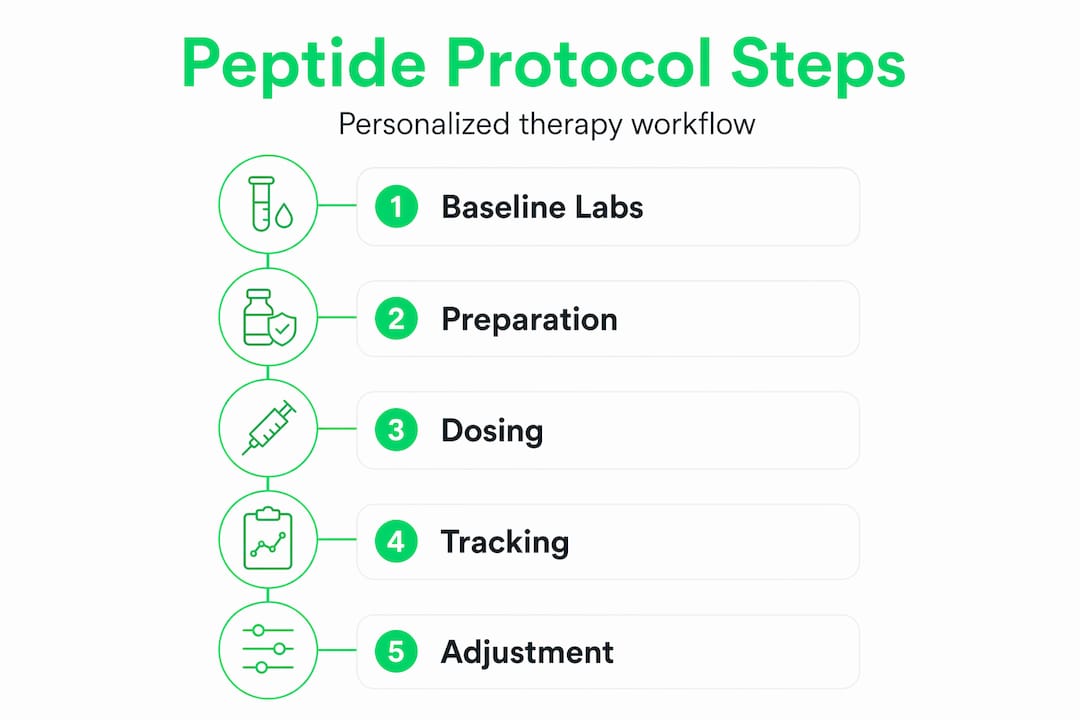
Executing your personalized peptide protocol step by step
A written protocol is not optional. Predefined monitoring criteria and scheduled labs should be established before your first dose, not improvised as you go. This principle separates people who get measurable results from those who are just experimenting.
Here is the core execution workflow for a safe peptide performance tracking workflow:
- Define your goal specifically. "Improve recovery" is not a goal. "Reduce delayed onset muscle soreness duration from 48 hours to under 24 hours over 8 weeks" is a goal you can actually measure.
- Set your starting dose at 50 to 70% of the standard therapeutic range. Let your body establish tolerance before moving up.
- Write your dose-change criteria before you start. Example: "I will increase dose only if IGF-1 is below my target range at week 8 AND I have no adverse symptoms."
- Schedule your 6 to 8 week lab retest. This early checkpoint biomarker retest is where you first evaluate efficacy and safety before committing to a longer maintenance phase.
- Track symptoms weekly using quantified metrics. Rate sleep quality, energy, recovery, and any side effects on a consistent 1 to 10 scale. Weekly averages reveal trends that daily logging obscures.
- Do not change more than one variable at a time. If you add a peptide and increase a dose simultaneously, you will never know which change drove the result.
Symptom tracking done right
Most users either track everything obsessively or nothing at all. Both approaches fail. The goal is a weekly snapshot across a fixed set of metrics tied directly to your protocol's stated goals. If your protocol targets tissue repair, track pain scores, range of motion, and workout recovery time. If it targets cognitive performance, track focus duration, sleep quality, and mood stability.
| Tracking metric | Frequency | What to watch for |
|---|---|---|
| IGF-1 (GH protocols) | 6 to 8 weeks | Upward trend toward target range |
| Fasting glucose | 6 to 8 weeks | No more than 15 mg/dL rise from baseline |
| Subjective symptoms | Weekly average | Trend improvement over 4 to 6 weeks |
| Injection site reaction | After each dose | Persistent redness warrants review |
For guidance on peptide therapy benefits and safety by peptide class, it helps to understand what each compound is actually supposed to do so you know which metrics matter most. For a more structured breakdown, choosing peptides step by step walks through how to match compounds to goals before you commit to a stack.
Pro Tip: Set a calendar reminder for your 6 to 8 week lab retest the day you take your first dose. If you wait until "around that time," it usually becomes week 12 or never.
With the protocol established and dosing underway, it is important to understand and avoid common execution mistakes and troubleshooting strategies.
Common pitfalls in peptide therapy and troubleshooting tips
Even well-intentioned users derail their protocols in predictable ways. Here are the ones that cause the most damage:
- Adjusting doses based on feelings, not data. One rough week does not justify a dose change. Adjusting based on subjective feeling leads to inconsistent, ineffective dosing patterns that make it impossible to interpret your results.
- Skipping written criteria. If you have not written down what constitutes "success" or "stop," you will rationalize staying on a protocol longer than you should.
- Incorrect reconstitution technique. Bacteriostatic water must be added gently down the side of the vial, not injected directly onto the lyophilized cake, which can degrade the peptide. Reconstitution errors and cold-chain breaks are a leading cause of reduced effectiveness that users mistakenly blame on the peptide itself.
- Letting reconstituted peptides sit beyond their stability window. Most solutions are stable for 28 days refrigerated. After that, potency drops. Label every vial with the reconstitution date.
- Stacking too many peptides at once. Running BPC-157, TB-500, and a GH secretagogue simultaneously makes it impossible to attribute results or side effects to any single compound.
The most expensive mistake in peptide therapy is not buying a low-quality product. It is spending 12 weeks on a protocol you cannot interpret because you never defined what you were looking for in the first place.
For a closer look at common peptide therapy app pitfalls and what to watch for when building your digital tracking setup, the patterns are consistent across both platforms and protocols.
Understanding these pitfalls prepares you to evaluate your results effectively and anticipate expected outcomes.
Verifying results: Biomarker interpretation and ongoing monitoring
Result verification is where peptide outcome tracking explained properly diverges from guesswork. The key principle: biomarker trends relative to your baseline signal protocol efficacy, not absolute values compared to population averages. A single data point tells you almost nothing. A 6-week trend tells you everything.
Here is a structured verification workflow:
- Pull your 6 to 8 week labs. Compare each value directly to your pre-protocol baseline, not to reference ranges.
- Look for directional movement. IGF-1 trending upward for GH protocols is expected. Fasting glucose trending upward is a warning sign.
- Correlate biomarkers with symptom trends. If IGF-1 is rising but your performance metrics are flat, question whether IGF-1 is the right proxy for your specific goal.
- Set a maintenance schedule. Stable protocols warrant retesting every 3 to 6 months, with urgent retests if new symptoms emerge.
| Outcome signal | What it suggests | Recommended action |
|---|---|---|
| IGF-1 moving toward target range | Protocol is working | Maintain dose, retest at 3 months |
| Fasting glucose up more than 15 mg/dL | Metabolic stress signal | Reduce dose or pause, retest in 4 weeks |
| No biomarker change at 8 weeks | Subtherapeutic dose or non-responder | Reassess dose or peptide selection |
| Adverse symptoms persisting over 2 weeks | Possible intolerance | Stop and consult a physician |
Key safe peptide therapy steps include knowing your "stop criteria" before you start. If IGF-1 exceeds 300 ng/mL, if glucose spikes beyond your threshold, or if you experience persistent edema or joint pain, those are not things to push through. You can find a detailed breakdown of evaluating peptide effectiveness to understand how to read biomarker shifts in context.
Rethinking peptide therapy: Why data-driven personalization is the key to success
Here is the uncomfortable reality most peptide content does not say out loud: the majority of people using peptides are not actually learning anything about themselves. They are running open-ended protocols with no defined goals, no exit criteria, and no structured way to know if something is working. After 12 weeks, they either feel better (which they attribute entirely to the peptide) or they do not (which they attribute to a bad batch). Neither conclusion is reliable.
True predefined criteria and structured checkpoints are what separate measurable outcomes from expensive guessing. But there is a deeper layer most users never reach: understanding which peptide in a stack is actually responsible for a given result. The only way to know that is to test compounds sequentially, not simultaneously. Run BPC-157 alone for 8 weeks with baseline and follow-up labs. Then, if you add a GH secretagogue, you now have a clean baseline from which to evaluate its independent contribution.
The pharmacokinetics piece is also widely ignored. Two peptides might both target tissue repair but have entirely different half-lives, peak action windows, and receptor affinities. Timing injections without understanding peptide classifications and mechanisms means you may be dosing at a suboptimal window and not realizing it.
Personalization in this context does not mean tailoring to preferences. It means designing a protocol specific to your biomarkers, your goals, and your body's measured response, then adjusting based on data rather than assumptions. That is a fundamentally different practice than most people are running.
Optimize your peptide therapy with Peptide AI
If building this kind of rigorous, data-driven protocol sounds like a lot to manage manually, that is because it is. Tracking dosing schedules, logging weekly symptom scores, correlating biomarker trends, and keeping reconstitution dates straight across multiple compounds is a real operational challenge.

Peptide AI is built specifically for this. The app lets you build custom peptide stacks from a catalog of 50+ compounds including BPC-157, TB-500, Semax, and more, with precise dosing schedules tied to your protocol timeline. The AI Insights Chatbot gives you real-time, research-backed guidance on dose adjustments based on your logged data, and the platform integrates with Apple Health, Oura Ring, and Whoop to pull in the biometric context that makes tracking meaningful. For anyone serious about peptide tracking best practices, this replaces the spreadsheet and the guesswork with a structured, evidence-based workflow.
Frequently asked questions
Why are peptides often injected rather than taken orally?
Most peptides have an oral bioavailability of roughly 1 to 2% because they break down in the digestive tract before reaching systemic circulation, making subcutaneous injection far more reliable for therapeutic effect.
What baseline tests should I get before starting peptide therapy?
At minimum, get a CMP, CBC, fasting glucose and insulin, HbA1c, and inflammation markers like hsCRP before starting any protocol, with IGF-1 added for growth hormone secretagogue stacks.
How often should I retest biomarkers during peptide therapy?
After your first 6 to 8 week checkpoint, stable protocols typically call for retesting every 3 to 6 months, with urgent retesting if new symptoms or side effects develop.
What are signs I should adjust or stop my peptide dose?
Predefined biomarker thresholds such as IGF-1 above 300 ng/mL, fasting glucose rising more than 15 mg/dL from baseline, or adverse symptoms persisting beyond two weeks are all legitimate criteria for reducing dose or stopping entirely.