
Peptide therapy sits at the intersection of cutting-edge science and serious personal risk. You have dozens of compounds to choose from, conflicting dosing advice scattered across forums, and almost no standardized guidance tailored to your specific biology, goals, or health history. That combination makes it easy to either overcommit to a protocol that doesn't fit your needs or, worse, expose yourself to unnecessary harm. This guide cuts through the noise with a structured, data-driven process for selecting, testing, and refining your peptide protocol so you can move forward with clarity and confidence.
Table of Contents
- What to know before you start: Safety, purity, and risks
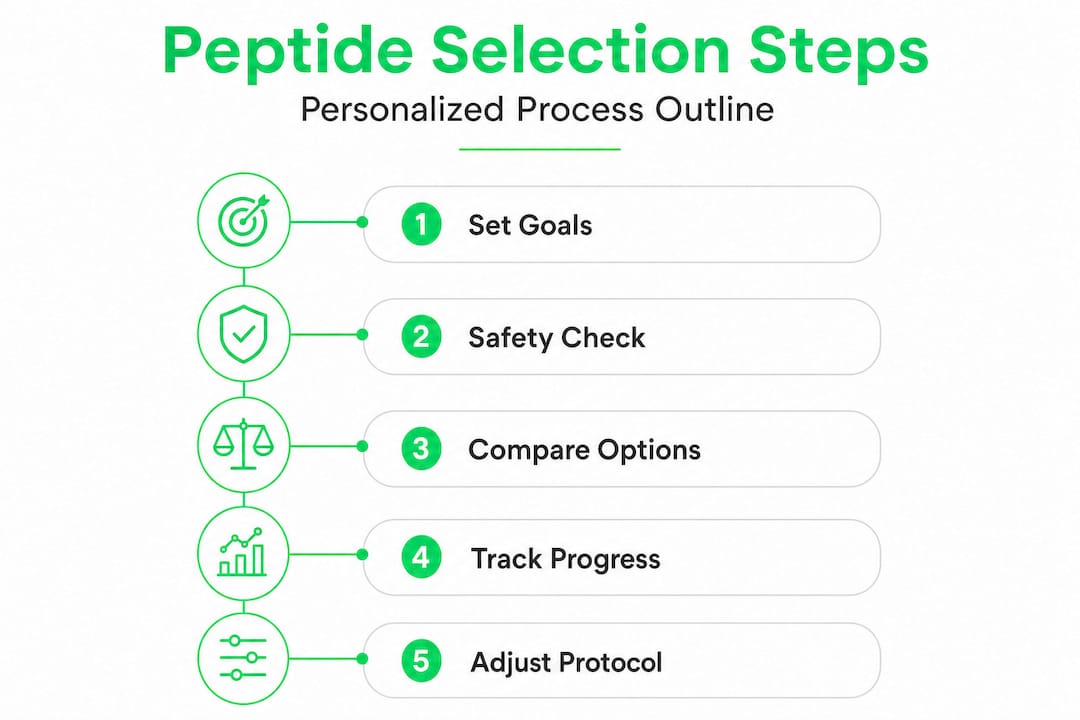
- Step 1: Define your goals and assess eligibility
- Step 2: Compare popular peptide options and protocols
- Step 3: Personalize with tracking, biofeedback, and technology
- Why personalized peptide selection demands skepticism and smart tech
- Ready to personalize your peptide protocol?
- Frequently asked questions
Key Takeaways
| Point | Details |
|---|---|
| Prioritize peptide safety | Always verify purity, legal status, and source before starting any protocol. |
| Personalize your approach | Tailor peptide selection and dosing to your health goals and baseline biomarkers. |
| Track outcomes with data | Monitor your biomarkers and use technology to refine peptide regimens safely. |
| Avoid unsafe scenarios | Never use peptides if pregnant or with active cancer due to documented risks. |
What to know before you start: Safety, purity, and risks
Before you touch a peptide, you need a firm grasp on what separates a legitimate, quality-tested compound from something that could seriously harm you. The peptide market is fragmented and largely unregulated in the research space, which creates real variability in product quality.
Understanding the legal and regulatory landscape
Peptides fall into a spectrum of legal categories. Some, like FDA-approved therapeutic peptides (semaglutide, for example), are prescribed under strict clinical guidelines. Others are classified as research chemicals, meaning they haven't been approved for human use and are sold with the disclaimer "for research purposes only." That label does not mean they're safe to use. It means they haven't been vetted by regulatory bodies for human administration.
The risks with synthetic peptide risks from unregulated sources are real and documented. Contamination with lipopolysaccharide (LPS) endotoxins, bacterial byproducts that trigger severe immune responses, is one of the most common hazards. Variable purity means you may be injecting 70% of your intended compound and 30% of something else entirely.
What quality documentation actually looks like
According to clinical safety reviews, you should prefer FDA-approved peptides when available, and any research peptide you consider must come with a Certificate of Analysis (CoA) showing HPLC purity above 95%, mass spectrometry (MS) verification, and ideally orthogonal testing. If a vendor can't produce those documents on demand, stop there.
The safest sourcing route for human use remains 503A and 503B compounding pharmacies, which operate under FDA oversight. These pharmacies formulate to prescription standards, meaning purity, sterility, and dosing accuracy are held to a regulatory bar.
Key documentation requirements to demand from any source:
- Certificate of Analysis (CoA) with HPLC purity above 95%
- Mass spectrometry (MS) confirmation of molecular identity
- Endotoxin testing results (LAL assay preferred)
- Sterility testing where applicable
- Third-party lab verification, not just internal testing
Always consult a licensed medical professional before starting any peptide regimen. This isn't a formality. Baseline bloodwork, a complete medical history review, and professional guidance on contraindications are non-negotiable steps for anyone serious about safety.
Pro Tip: Review peptide safety basics before comparing specific compounds. Getting the fundamentals right here protects everything downstream.
If you're exploring regulated performance peptides, compounding pharmacy sourcing is especially important since many of these compounds exist in both legitimate and gray-market forms.
Step 1: Define your goals and assess eligibility
You cannot select the right peptide without knowing precisely what you're trying to achieve. "Get healthier" or "recover faster" are not goals. They're directions. Effective peptide protocol design starts with specificity.

Mapping your therapeutic objective
Peptide therapy can serve a wide range of purposes, and the compounds that work well for one goal often have little relevance to another. Common goal categories include:
- Tissue repair and injury recovery (BPC-157, TB-500)
- Growth hormone optimization (Ipamorelin, CJC-1295, Tesamorelin)
- Cognitive enhancement and neuroprotection (Semax, Selank, Dihexa)
- Fat loss and metabolic support (AOD-9604, Tesamorelin)
- Immune modulation and inflammation control (Thymosin Alpha-1, LL-37)
- Longevity and cellular repair (Epitalon, MOTS-c)
Each category has different mechanisms, risk profiles, and monitoring requirements. Mixing goals at the start almost always backfires. Pick one primary objective, build your first protocol around it, and expand only after you have clear data.
Screening for safety exclusions
Clinical guidance is explicit about who should not use investigational peptides: avoid them entirely during pregnancy due to unknown developmental effects, and avoid them if you have active cancer because several peptides promote angiogenesis (the growth of new blood vessels), which can accelerate tumor progression. Short cycles are strongly recommended for investigational peptides to limit cumulative exposure while you gather personalized data.
Your eligibility is not a one-time assessment. Health status changes. Quarterly bloodwork and regular medical check-ins keep your protocol aligned with your current biology, not a snapshot from six months ago.
Baseline biomarkers worth collecting before you start
Before your first dose, establish your baselines. For most goals, this means:
- IGF-1 (insulin-like growth factor 1, relevant for GH-releasing peptides)
- Complete metabolic panel (kidney and liver function)
- Complete blood count (immune baseline)
- Fasting insulin and glucose (metabolic health)
- CRP and ESR (inflammation markers)
- Testosterone, estradiol, and cortisol (hormonal context)
Tracking performance and recovery peptides without this baseline data is essentially guessing. You need numbers to compare against when you start evaluating whether a protocol is actually working.
Pro Tip: Run your bloodwork through a physician who's familiar with peptide therapy so they can flag any values that would disqualify certain compounds before you commit to a protocol.
Step 2: Compare popular peptide options and protocols
With clear goals and a clean safety screen, you're ready to compare actual compounds. The table below covers the most well-researched options by goal category, including realistic beginner dosing ranges and cycle lengths.
| Peptide | Primary use | Beginner dose | Typical cycle | Key monitoring |
|---|---|---|---|---|
| BPC-157 | Tissue repair, gut healing | 250-500 mcg/day SC | 4-8 weeks | Inflammation markers |
| TB-500 | Systemic recovery, flexibility | 2-5 mg/week SC | 4-6 weeks | Symptom log |
| Ipamorelin | GH pulse stimulation | 200-300 mcg/day SC | 8-12 weeks | IGF-1, fasting glucose |
| CJC-1295 (no DAC) | GH optimization | 100-300 mcg/day SC | 8-12 weeks | IGF-1 |
| Semax | Cognitive function, BDNF | 200-600 mcg/day IN | 2-4 weeks | Mood and cognition log |
| Selank | Anxiety reduction, cognition | 250-500 mcg/day IN | 2-4 weeks | Subjective stress scores |
| Epitalon | Longevity, telomere support | 5-10 mg/day SC | 10-20 days, 2x/year | Broad bloodwork |
| Thymosin Alpha-1 | Immune modulation | 1-1.6 mg 2x/week SC | 4-12 weeks | CBC, immune markers |
SC = subcutaneous injection; IN = intranasal
Simple protocols versus stacking
The single most common mistake beginners make is stacking too early. A stack means running two or more peptides simultaneously, which makes it nearly impossible to isolate which compound is producing a specific effect (positive or negative). Beginner protocols should always start with one peptide at the lowest effective dose.
Clinical frameworks confirm this approach: start with one peptide at a conservative dose, such as 250-500 mcg subcutaneously daily for BPC-157 or a comparable conservative dose for your chosen compound, cycle 4-8 weeks, then assess your biomarkers before making any changes or additions.
Key principles for your first protocol:
- One peptide at a time, minimum 4-week cycle before evaluating
- Document every injection: dose, time, site, and how you feel within 2 hours
- Don't adjust dose mid-cycle unless you experience an adverse reaction
- Wait at least 2 weeks off-cycle before introducing a second compound
Explore protocol types in detail to understand how pulse dosing, continuous dosing, and front-loaded cycles differ and when each approach makes sense for your goal.
Step 3: Personalize with tracking, biofeedback, and technology
Selecting a starting protocol is only the beginning. What separates people who get results from those who spin their wheels is how rigorously they track, interpret, and act on their data.
Biomarker and biofeedback tracking
The objective data you're looking for depends on your goal. For GH-related peptides, IGF-1 is your primary marker. For healing peptides like BPC-157, inflammation markers (CRP, IL-6) and subjective pain scores give you meaningful signal. For cognitive peptides, validated questionnaires for mood, focus, and anxiety are legitimate measurement tools.
Don't underestimate subjective measures. Sleep quality, energy levels, mood stability, and workout recovery are real outcomes that deserve systematic tracking. Keep a daily log with consistent entries at the same time each day so your data reflects patterns rather than noise.
Manual versus app-based tracking
| Feature | Manual tracking (spreadsheet/journal) | App-based tracking |
|---|---|---|
| Dose logging | Possible but error-prone | Automated with reminders |
| Biomarker trend analysis | Manual calculations required | Visualized automatically |
| Wearable integration | None | Apple Health, Oura, Whoop |
| Cycle management | Calendar-based | Built-in cycle alerts |
| AI-driven insights | None | Real-time recommendations |
| Protocol library | None | 50+ cataloged peptides |
Personalizing via biomarkers and bloodwork, with mobile app integration for tracking cycles, doses, and outcomes against your baseline, is the standard recommended approach for biohackers who want reproducible results.
Structured iteration process
- Complete your baseline bloodwork and log it as your "week zero" reference
- Start your protocol and log every variable: dose, timing, sleep, energy, symptoms
- At week 4, run repeat bloodwork and compare against baseline
- Rate your subjective outcomes (1-10 scale for each goal area)
- Adjust dose or timing only after reviewing at least 4 weeks of data
- If adding a second compound, treat it as a new experiment with its own baseline
Tracking peptide outcomes with this level of structure gives you actual evidence about what's working in your specific biology, which is the foundation of personalized peptide tools designed for serious self-optimizers.
Pro Tip: Sync your wearable data (heart rate variability, sleep stages, recovery scores) alongside your peptide log. These passive metrics often reveal subtle biological shifts before your subjective sense catches up.
Why personalized peptide selection demands skepticism and smart tech
Here's the thing most peptide content won't tell you directly: a significant portion of the enthusiasm around specific compounds is built on animal studies, not robust human trials. That doesn't mean the compounds are ineffective. It means the confidence level that online communities project often exceeds what the actual evidence supports.
The tension is real. Proponents of peptide therapy, including researchers, physicians, and biohackers, highlight remarkably specific signaling mechanisms and observed clinical benefits. Skeptics, many of them also researchers, point to translation gaps between preclinical animal data and human outcomes, along with legitimate concerns about off-label oncologic risks for compounds that interact with growth pathways.
Both sides are right. That's what makes this space genuinely complicated.
The answer isn't to avoid peptides or to ignore the skeptics. It's to treat your protocol as a structured experiment with proper controls: baseline measurements, controlled variables, defined endpoints, and honest evaluation of your data. The biohacking community's best practitioners already operate this way. They're not just stacking compounds because someone on a forum said it worked. They're running short cycles, measuring outcomes, and iterating based on what their own biology tells them.
Smart technology accelerates this process without adding false certainty. When an app tracks your doses, flags timing deviations, surfaces biomarker trends, and cross-references your outcomes against real-world peptide evidence, it makes rigorous self-experimentation accessible rather than overwhelming.
The biggest risk isn't using peptides. It's using them without a system for knowing whether they're working or hurting you.
Ready to personalize your peptide protocol?
Building a safe, evidence-informed peptide protocol doesn't have to mean managing spreadsheets, manually cross-referencing research papers, and guessing at adjustments mid-cycle. There's a better way to do this.

Peptide AI brings together everything this guide outlines into one mobile platform. Track your BPC-157, TB-500, Semax, or any of 50+ cataloged peptides with precise dosing schedules. Log your biomarker data and sync it with Apple Health, Oura Ring, or Whoop for a complete picture of how your protocol is affecting your biology. The AI Insights Chatbot gives you real-time, research-backed guidance, and the AI Body Scanner tracks your physical transformation over time. If you're ready to move from guesswork to a genuinely personalized system, get started with Peptide AI and bring the same rigor to your biology that you'd apply to any serious performance goal.
Frequently asked questions
What is the safest way to source peptides?
The safest sourcing approach is to use FDA-approved peptides when available or obtain compounded peptides from a 503A/503B pharmacy under medical supervision. Always require a full CoA with HPLC purity above 95% and independent lab verification before using any compound.
How do beginners avoid side effects with peptide therapy?
The most effective strategy is to start with one peptide at a conservative dose and keep your first cycle to 4-8 weeks. Conservative starting doses, like 250-500 mcg daily for BPC-157, allow you to monitor IGF-1, inflammation, and recovery markers before making any adjustments.
Who should NOT use peptides?
Peptides should be avoided during pregnancy and in anyone with active cancer, particularly because several peptides promote angiogenesis, which carries oncologic risk in cancer contexts. Always complete a medical screening before beginning any protocol.
How do I personalize my peptide protocol for best results?
Personalization depends on pairing your bloodwork baselines with consistent tracking of doses, timing, and both objective and subjective outcomes. Mobile app integration is the most practical way to manage this process accurately and catch trends early so you can adjust with confidence.