
The peptide market has exploded, and with it has come a flood of bold claims about muscle gain, faster recovery, and optimized performance. The reality is more complicated. Limited research supports the idea that commonly marketed peptides directly increase hypertrophy in healthy, trained individuals. If you are already lifting seriously and considering adding peptides to your protocol, you need more than marketing copy. This guide cuts through the noise, explains what different peptides actually do inside your body, reviews the real human data, and gives you a practical framework for deciding what is worth tracking.
Table of Contents
- What peptides are (and aren't): Nutrition vs. pharmacology
- How peptides work: Mechanisms for muscle growth and recovery
- What the science actually shows: Evidence from human studies
- Risks, regulations, and what to track for safer, smarter use
- Our take: What really works, and why caution is critical
- Take your next step with peptides, safely and intelligently
- Frequently asked questions
Key Takeaways
| Point | Details |
|---|---|
| Different peptide types | Not all peptides are alike—distinguish between nutritional, supplement, and pharmacologic types to avoid confusion. |
| Mechanisms vs. evidence | Many peptides have logical mechanisms for muscle support, but strong humanproof—especially for trained lifters—is limited. |
| Tracking safety is essential | Many peptides come with regulatory uncertainties, so monitor health outcomes and use vetted apps if you proceed. |
| Therapeutic breakthroughs differ | The biggest science-backed muscle gains come from medical therapies, not most peptides marketed to athletes online. |
What peptides are (and aren't): Nutrition vs. pharmacology
Not every peptide works the same way, and this distinction matters more than most people realize. The word "peptide" describes any short chain of amino acids, but that single label covers an enormous range of molecules with completely different mechanisms, regulatory statuses, and evidence profiles. Treating them as one category is one of the biggest mistakes bodybuilders make when building a protocol.
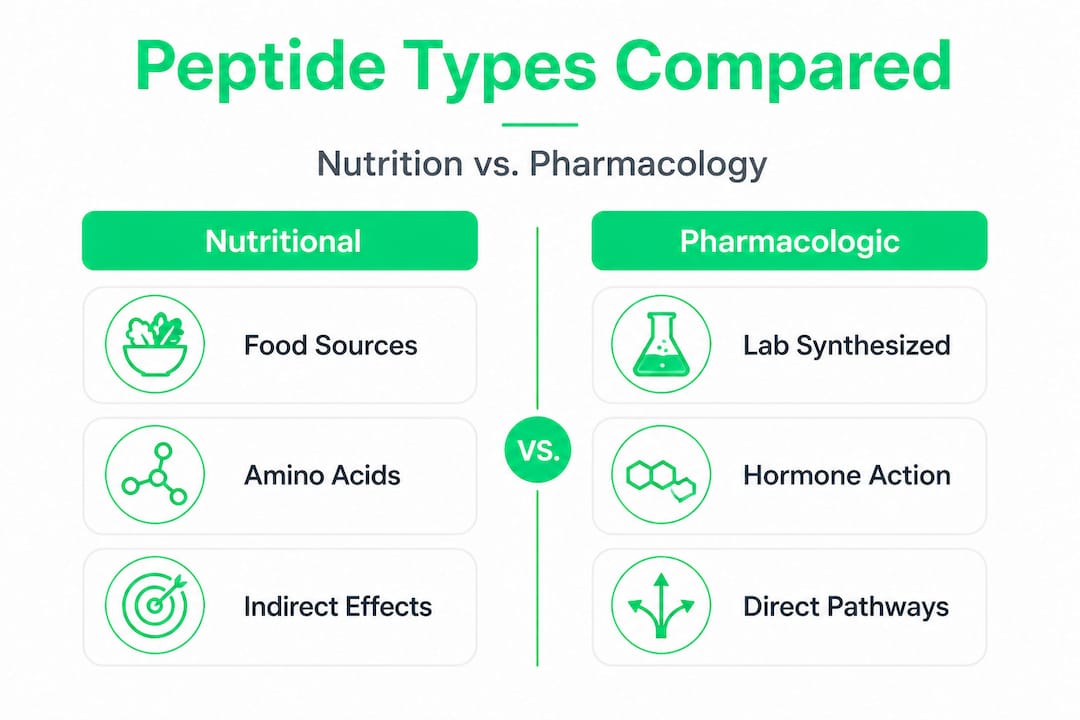
The first major category is nutritional or bioactive peptides. These come from food proteins like whey, casein, or collagen and are produced through digestion or enzymatic hydrolysis. They work mainly as amino acid substrates for muscle protein synthesis and may have mild anti-inflammatory or signaling effects. Examples include whey hydrolysates and collagen peptide supplements. They are widely available, legal, and moderately well-studied, though often in populations that are untrained or elderly.
The second category is pharmacologic peptides, which target specific endocrine or cellular pathways. These include growth hormone secretagogues like ipamorelin and CJC-1295, which stimulate natural GH release, and experimental agents that block myostatin or activin signaling. Their mechanisms are far more potent and targeted, but so are their regulatory implications and safety unknowns. Understanding types of peptide supplements and categories of peptides helps you evaluate what you are actually purchasing.
| Feature | Nutritional peptides | Pharmacologic peptides |
|---|---|---|
| Source | Food proteins, enzymatic hydrolysis | Synthetic, lab-produced |
| Primary effect | Amino acid supply, mild recovery | GH/IGF-1 stimulation, signaling |
| Evidence level | Moderate (recovery, some strength) | Mostly mechanistic or hormonal |
| Regulatory status | Legal supplement | Often banned or investigational |
| Typical use | Daily supplementation | Protocol-based injection cycles |
A key nuance for bodybuilders is distinguishing between peptide types and their relevance to your specific goals. Peptides in the nutritional sense can influence outcomes in small trials, but they are not equivalent to the pharmacologic compounds circulating in bodybuilding communities.
Pro Tip: Many peptides sold online as "muscle builders" have vastly different human research profiles. Always check what you are actually getting, what population it was studied in, and whether the endpoint measured was real muscle hypertrophy or just a hormone number on a lab panel.
How peptides work: Mechanisms for muscle growth and recovery
Having defined the important categories, let's break down exactly how peptides are supposed to work inside your body. There are three main pathways researchers focus on, each with a different strength of evidence and a different practical relevance for trained athletes.
Pathway 1: GH/IGF-1 signaling. Growth hormone secretagogues stimulate the pituitary to release GH, which then drives IGF-1 production in the liver. IGF-1 activates downstream anabolic pathways including PI3K/Akt/mTOR, which promote muscle protein synthesis and satellite cell activation. This is the most discussed pathway in bodybuilding circles, and GH/IGF-1 targeting peptides do produce measurable hormone changes. The question is whether those hormone changes translate into actual muscle size gains in people already training hard.
Pathway 2: mTOR activation via amino acid substrate. Nutritional peptides supply leucine-rich amino acids that directly activate mTOR signaling in muscle cells. After a hard training session, muscle protein breakdown accelerates, and providing a rapid source of amino acids through fast-absorbing peptides can tip the balance toward net synthesis. Whey peptide mTOR activation is one of the more mechanistically solid findings in sports nutrition research. This is less about a pharmacologic shortcut and more about fueling the anabolic window efficiently.
Pathway 3: Myostatin/Activin inhibition. Myostatin is a protein that limits muscle growth. Blocking it, at least in animal models, produces dramatic increases in muscle mass. Activin A works through a similar pathway. Antibody therapies targeting these proteins exist and produce measurable results in controlled trials. However, these are not the peptides sold in online research chemical stores.
Here is what actually happens after you take a peptide:
- The peptide is absorbed, either orally (if digestively stable) or via injection directly into systemic circulation.
- It binds to its target receptor, whether on the pituitary, muscle cell membrane, or elsewhere.
- Downstream signaling cascades activate, triggering hormone release, mTOR phosphorylation, or gene expression changes.
- Over hours to days, those signals influence muscle protein synthesis rates, satellite cell activation, or inflammatory resolution.
- Actual tissue change, meaning measurable muscle gain or faster recovery, requires consistent stimulus and sufficient training load on top of the peptide signal.
Research on top performance peptide examples shows that step 5 is where most protocols fall short. Mechanistic plausibility at step 3 does not guarantee a meaningful outcome at step 5 in an already-trained person. One trial investigating PeptiStrong supplementation found maintained muscle strength and recovery restoration post-exercise in males, but this was a nutritional peptide in a specific context, not a pharmacologic compound.
What the science actually shows: Evidence from human studies
Understanding the theory is useful, but what about hard human data? Let's look at the real studies and what they actually measured.

The most important thing to recognize is that most human trials on bodybuilding-relevant peptides measure hormone levels as their primary endpoint, not muscle cross-sectional area or maximal strength output. A peptide that raises your GH pulse by 30% looks impressive on paper. Whether that GH increase actually translates to more lean mass in a trained person lifting four days a week is a different question entirely.
Here is a breakdown of findings by peptide category:
- GH secretagogues (ipamorelin, GHRP-2, CJC-1295): Human trials confirm GH and IGF-1 elevations. Direct effects on lean mass in trained, healthy adults remain poorly documented. Most trials used older adults, metabolic disease patients, or very short intervention windows.
- Nutritional peptides (whey hydrolysates, collagen, PeptiStrong): Small but real effects on recovery speed, soreness reduction, and maintenance of strength around exercise bouts. More applicable to the recovery side of the equation than raw hypertrophy.
- Myostatin/Activin inhibitors (bimagrumab, trevogrumab): Clear, controlled human data on muscle gain through antibody-based therapies exists, particularly in populations with sarcopenia or muscle-wasting conditions. These produce legitimate increases in muscle mass. They are pharmaceutical-grade antibodies, not peptides you can order from a supplement retailer.
"Most human peptide trials focus on hormone changes or indirect outcomes, not actual muscle size or strength in trained adults. Dramatic gains seen in some studies come from therapies far outside the consumer supplement market."
The evidence is clear that direct hypertrophy evidence is lacking for most commonly used peptides in healthy, trained individuals. That is not a reason to dismiss peptides entirely. Absence of proof is not proof of absence, and recovery benefits have real value for athletes who train at high volume. But it does mean you should be skeptical of anyone claiming a specific peptide stack will add 10 pounds of muscle in 12 weeks.
The distinction also matters between muscle healing after injury, reduction in delayed-onset muscle soreness, and direct hypertrophic gain. Performance peptide human trials tend to show more consistent results on the recovery and soreness side, which has indirect benefits for training capacity over time. More volume, less soreness, and faster turnaround between sessions can compound into meaningful adaptation, even if the peptide itself is not directly building muscle. For a more detailed breakdown of what works and where the gaps are, peptide efficacy challenges are worth understanding before you build a protocol.
Risks, regulations, and what to track for safer, smarter use
If you are considering or already using peptides, you need tools for safety and effectiveness. Here is what to know before you inject, swallow, or stack.
Step 1: Check regulatory status. Many GH secretagogues and performance peptides are banned by WADA, which matters if you compete in tested sports. Even if you are not a competitive athlete, regulatory status signals something about the risk-to-benefit profile that regulators have evaluated. FDA status matters too. Most pharmacologic peptides sold online exist in a legal gray area, not explicitly approved for human use but also not always actively prosecuted.
Step 2: Evaluate your source critically. Gray-market peptides are notoriously inconsistent in purity and concentration. Independent lab testing has found significant discrepancies between label claims and actual peptide content in samples purchased from popular online vendors. Contamination with bacterial endotoxins or misidentified compounds is a real risk.
Step 3: Monitor for side effects systematically. Common reported issues with GH secretagogues include water retention, increased cortisol, and altered fasting glucose. Recovery peptides like BPC-157 are considered investigational due to a lack of quality human safety data, despite widespread use in fitness communities. Widespread use does not equal safety, and anecdotal reports do not replace controlled data.
When it comes to tracking your results, these are the parameters that actually tell you whether something is working:
- Muscle circumference measurements at consistent points under consistent conditions
- Strength output across key compound lifts, tracked weekly over multi-week blocks
- Recovery time between sessions, including subjective soreness and wearable data like HRV and sleep quality
- Bloodwork, including IGF-1 levels, fasting glucose, and a basic metabolic panel, taken at baseline and intervals throughout any protocol
Using apps that integrate safe peptide use principles with real-time biometric tracking removes the guesswork. If your bloodwork is shifting in the wrong direction, you want to know at week four, not week sixteen. Resources on peptide safety insights can give you a clearer picture of what to watch for across different compound categories.
Pro Tip: Always get baseline bloodwork before starting any peptide protocol. Never assume supplement label accuracy, and consult a clinician who understands the pharmacology before layering compounds. The cost of a blood panel is nothing compared to the cost of discovering a side effect too late.
Our take: What really works, and why caution is critical
The uncomfortable truth about peptides for muscle growth is this: the compounds with the clearest, most controlled human data for increasing muscle mass are pharmaceutical-grade antibody therapies targeting myostatin and activin. They are not available at your local supplement store. They are not what most bodybuilders are discussing in forums.
What is widely used in fitness communities, including GH secretagogues, BPC-157, and various peptide blends, has mechanistic plausibility that far exceeds its clinical proof. These compounds can do interesting things to hormone panels and may genuinely help with recovery. But for a well-trained athlete already optimizing sleep, protein intake, and progressive overload, the marginal benefit of adding a gray-market peptide stack is genuinely unknown. That is not hype. It is just honest.
We have seen the pattern repeatedly. Someone stacks three peptides, trains consistently for 12 weeks, and credits the peptides for their progress. But those 12 weeks also involved dialed-in nutrition, better sleep, and higher training motivation. Isolating the peptide effect is nearly impossible without controlled conditions.
"Chasing shortcut compounds often overshadows the basics that actually move the needle. You cannot out-protocol bad sleep and inconsistent training."
That said, smart peptide use is not irrational. What makes it smart is building a protocol around what you can actually measure. If your HRV improves, your soreness resolves faster, and your training volume increases over a block, something is working, whether you attribute it to the peptide or not. The key is measurement. Understanding risks of synthetic peptides before you start is part of building that intelligent approach. Data-driven athletes who track outcomes honestly will always make better decisions than those who rely on forum testimonials.
Take your next step with peptides, safely and intelligently
Ready to move beyond confusion and hype? Here's how to start with confidence.
Peptide AI is built specifically for people who want more than guesswork when it comes to peptide protocols. The platform catalogs over 50 peptides including BPC-157, TB-500, and Semax, with research-backed dosing schedules, an AI Insights Chatbot for real-time data-backed recommendations, and an AI Body Scanner that tracks your physical transformation over time.

What separates serious users from those spinning their wheels is data. Peptide AI integrates with Apple Health, Oura Ring, and Whoop so your recovery metrics, sleep quality, and training readiness feed directly into your protocol insights. Whether you are just starting to explore peptide therapy or already running an advanced stack, the app gives you the intelligence to track what is actually changing in your body. Stop guessing. Start measuring.
Frequently asked questions
Do peptides really build muscle in healthy, advanced lifters?
Current clinical evidence does not show significant muscle hypertrophy in well-trained individuals from most commonly used peptides. Effects on hormone levels have been documented, but translating that to actual muscle gain in already-trained people remains unproven.
What are the main risks with peptide use for bodybuilding?
Many peptides are unregulated, sourced from gray-market suppliers, and some are banned in sport. Human safety data is often limited or entirely absent, making risk profiling difficult without regular bloodwork and clinical oversight.
What pathway is most promising for true muscle gain?
Blocking the myostatin/activin pathway produces the clearest controlled data for real increases in muscle mass, but these are antibody therapies used in clinical settings, not the peptides sold online as muscle builders.
How can I safely track the effects of peptides on my performance?
Track muscle circumference, strength output, HRV, and sleep data consistently, and pair these with regular bloodwork to catch any adverse metabolic shifts early. Dedicated tracking apps that integrate wearable data make this significantly more accurate.
Is there proven benefit for using peptides for quicker recovery?
Some small trials show nutritional peptides may support recovery and strength maintenance around exercise bouts, but results are modest and may not generalize broadly to all athletes or training contexts.