
Peptide dosing guides look authoritative on the surface — precise numbers, neat tables, confident language. But most of them are built on reconstitution math and community anecdote rather than controlled human trials. As one overview of peptide stacking basics notes, the majority of these protocols are effectively templates derived from half-life logic and peer-to-peer practice, not robust clinical evidence. That gap matters. This guide walks you through every step of the process — what to prepare, how to calculate accurately, what real-world ranges look like, and how to verify results safely so you can move forward with both clarity and appropriate skepticism.
Table of Contents
- Peptide dosing basics: What you need to know before starting
- Preparation and calculation: Reconstitution, concentration, and syringe math
- Real-world dosing ranges, cycles, timing, and practical tips
- Troubleshooting, safety, and verification: Avoiding mistakes and optimizing results
- The uncomfortable truth about peptide dosing guides: What most get wrong
- Get personalized, AI-guided dosing with Peptide AI
- Frequently asked questions
Key Takeaways
| Point | Details |
|---|---|
| Evidence gaps | Most peptide dosing guides are based on protocols, not robust clinical data, especially for fitness and recovery applications. |
| Calculation matters | Accurate peptide dosing requires correct reconstitution math and syringe unit conversion for safety and effectiveness. |
| Start low, monitor | Begin with low doses, titrate carefully, and track tolerability or side effects to minimize risks. |
| Cycle and timing | Typical protocols use cycles and fasted injection timing—most users opt for 500 mcg/day BPC-157 and 250–500 mcg/day AOD-9604. |
| Safety first | DIY injections carry real risks; always verify sources, follow proper handling, and consult medical professionals when uncertain. |
Peptide dosing basics: What you need to know before starting
Before you draw a syringe, you need to understand the landscape. Most peptides used in the fitness and recovery space — BPC-157, TB-500, Semax, and others — are research chemicals or unapproved drugs. That means their dosing parameters come from animal studies, extrapolated pharmacokinetics, and the accumulated experience of self-experimenting communities, not from FDA-approved prescribing information.
Important: Using peptides for fitness and recovery is considered off-label use. For most of these compounds, large-scale, peer-reviewed human safety and efficacy trials simply do not exist yet. Proceed with full awareness of this status.
Take two of the most popular examples. BPC-157 and TB-500 are widely used for injury recovery, yet the evidence supporting their use in humans is described as extremely thin and not rigorously studied. This is not a reason to dismiss these compounds entirely — it is a reason to approach them with calibrated caution rather than unearned confidence. Meanwhile, doctors are raising alarms about side effects from DIY peptide injections, including contamination risk, improper dosing, and unknown long-term safety signals.
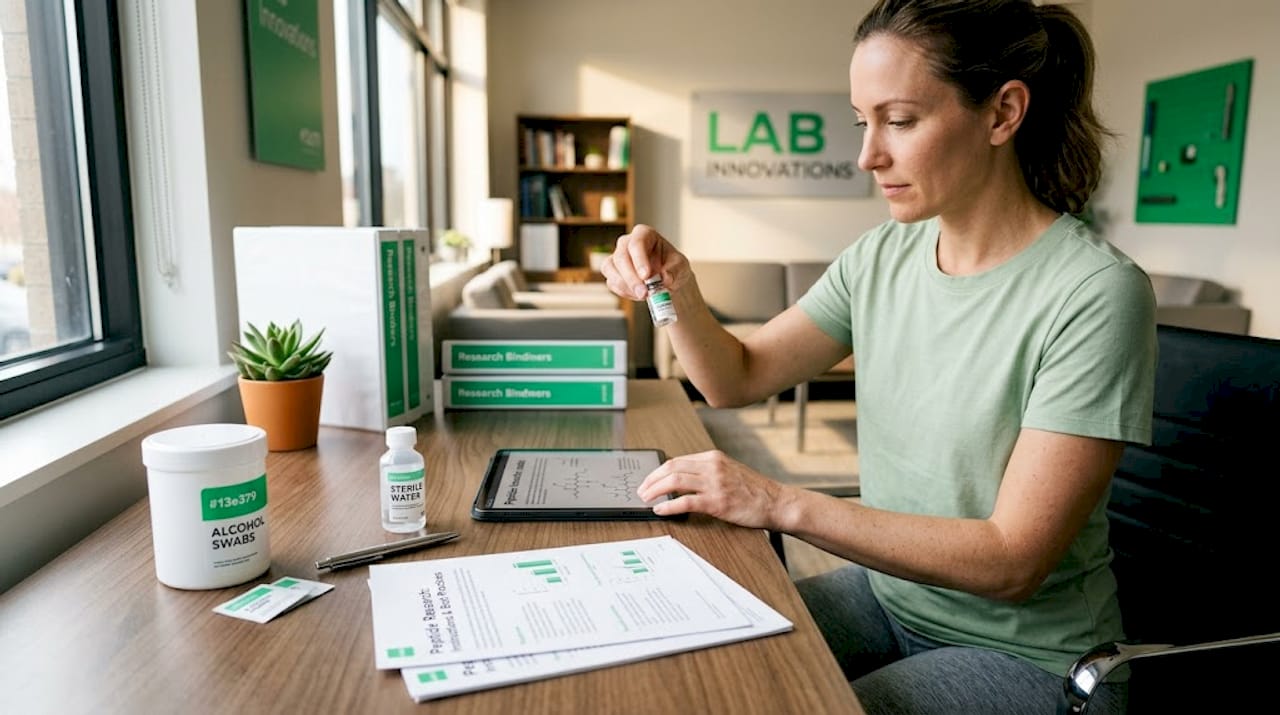
Before you begin any protocol, gather the following materials:
- Lyophilized peptide vials from a verified, third-party tested source
- Bacteriostatic water (BAC water) for reconstitution
- U-100 insulin syringes (typically 1 mL, 100 units)
- Sterile alcohol swabs for prep
- Refrigeration at 2-8°C (36-46°F) for storage after mixing
Understanding peptide therapy safety and the associated peptide efficacy challenges is foundational to responsible use.
Here is a quick comparison of popular fitness and recovery peptides, their intended uses, and where the evidence currently stands:
| Peptide | Primary use | Evidence level | Administration |
|---|---|---|---|
| BPC-157 | Joint/tendon recovery | Animal data; limited human trials | Subcutaneous or intramuscular |
| TB-500 | Systemic healing, flexibility | Preclinical; no major human RCTs | Subcutaneous |
| AOD-9604 | Fat metabolism | Phase II trials; limited scope | Subcutaneous, fasted |
| Semax | Cognitive enhancement | Russian clinical data; limited Western trials | Intranasal or subcutaneous |
| Ipamorelin | GH stimulation | Human studies exist; mostly short-term | Subcutaneous |
Pro Tip: Always verify your peptide source with third-party Certificate of Analysis (CoA) documentation. Purity levels below 98% introduce unknowns that make dosing unreliable regardless of how precise your math is.
Preparation and calculation: Reconstitution, concentration, and syringe math
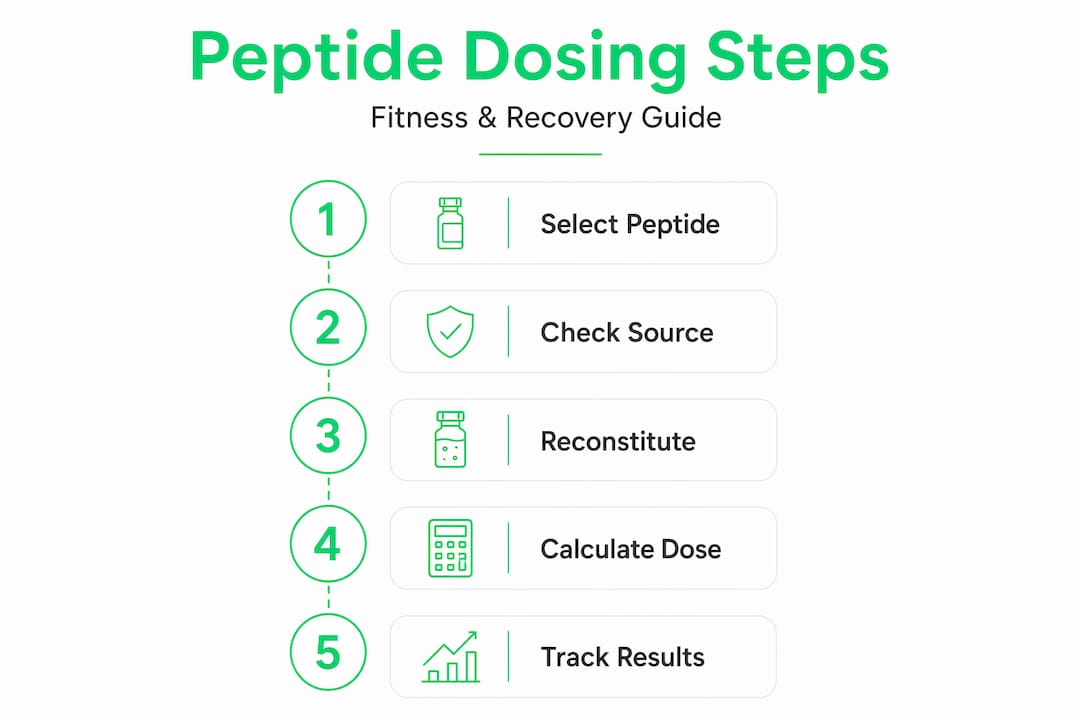
Mixing and measuring peptides is not complicated, but errors here cascade into every injection that follows. The most common misunderstanding is treating syringe "units" as mass — they are not. Units on a U-100 syringe represent volume (0.01 mL per unit), so your target dose in micrograms (mcg) must be converted into a volume based on your reconstitution concentration.
Storage reminder: After reconstitution with BAC water, most peptides remain stable for 4 to 6 weeks under refrigeration. Do not freeze reconstituted peptides. Discard any vial showing cloudiness, particles, or unusual color.
Here is the core formula:
Concentration (mcg/unit) = Total peptide amount (mcg) ÷ Total volume added (mL) ÷ 100
So if you add 2 mL of BAC water to a 5,000 mcg BPC-157 vial:
- 5,000 ÷ 2 = 2,500 mcg/mL
- 2,500 ÷ 100 = 25 mcg per unit
To dose 500 mcg, you draw 20 units. That math must be recalculated every time you change how much BAC water you add. As dosage calculation guides confirm, the number on the syringe barrel is purely volumetric — it has no inherent relationship to peptide mass until you build the formula yourself.
Step-by-step reconstitution protocol:
- Let your peptide vial and BAC water reach room temperature before handling
- Swab the rubber stopper on both vials with an alcohol swab and let dry for 10 seconds
- Draw your desired volume of BAC water into the syringe slowly
- Insert the needle into the peptide vial at an angle and let the water run down the side of the glass — never squirt directly onto the powder
- Remove the needle and gently swirl (do not shake) the vial until fully dissolved
- Label the vial with the date, concentration, and peptide name
- Refrigerate immediately and use within 4 to 6 weeks
The reconstitution guide from CalcMyPeptide reinforces the importance of gentle mixing and proper BAC water use throughout this process. Shaking the vial degrades the peptide chain — a mistake that costs you both potency and money.
Here is a quick-reference calculation table for common vial sizes and BAC volumes:
| Peptide vial | BAC water added | Concentration | Units for 250 mcg | Units for 500 mcg |
|---|---|---|---|---|
| 5 mg (5,000 mcg) | 1 mL | 50 mcg/unit | 5 units | 10 units |
| 5 mg (5,000 mcg) | 2 mL | 25 mcg/unit | 10 units | 20 units |
| 10 mg (10,000 mcg) | 2 mL | 50 mcg/unit | 5 units | 10 units |
| 2 mg (2,000 mcg) | 1 mL | 20 mcg/unit | 12.5 units | 25 units |
Keep this table handy. Recalculate whenever you order a different vial size or adjust your BAC water volume. Getting your peptide performance fundamentals right at the calculation stage prevents the majority of dosing errors users encounter downstream.
Pro Tip: Write your concentration directly on the vial with a marker. A 5 mg vial reconstituted with 2 mL is a completely different dosing reality than the same vial reconstituted with 1 mL. Confusion here leads to significant under or overdosing.
Real-world dosing ranges, cycles, timing, and practical tips
Now that your math is locked in, you need to choose an actual dose and structure your cycle. This is where most beginners get paralyzed, because the ranges in community guides are wide and context-dependent.
Here is what the commonly reported protocol data shows across the top fitness and recovery peptides:
| Peptide | Daily dose range | Common starting dose | Typical cycle length | Injection timing |
|---|---|---|---|---|
| BPC-157 | 200 to 1,000 mcg | 250 mcg | 4 to 12 weeks | Near injury site or subcutaneous |
| TB-500 | 5 to 20 mg/week | 5 mg loading | 4 to 6 weeks loading | Any subcutaneous site |
| AOD-9604 | 250 to 500 mcg/day | 250 mcg | 8 to 12 weeks on, 4 weeks off | Morning, fasted |
| Semax | 200 to 900 mcg/day | 200 mcg | 2 to 4 weeks on, 2 weeks off | Morning, intranasal or subcutaneous |
| Ipamorelin | 100 to 300 mcg/dose | 100 mcg | 8 to 12 weeks | Pre-sleep or post-workout |
For BPC-157 specifically, a commonly reported dosing range is 200 mcg to 1,000 mcg daily, with 500 mcg/day emerging as the most frequently cited middle ground across user communities. That does not make 500 mcg the scientifically optimal dose — it makes it the most commonly self-reported, which is a meaningful distinction.
For AOD-9604, protocol guidance typically specifies 250 to 500 mcg per day injected in a fasted state in the morning, with cycles of 8 to 12 weeks followed by a 4-week break. Importantly, AOD-9604 dosing guidance consistently emphasizes that higher doses do not appear to produce proportionally better outcomes — a pattern that shows up across multiple peptide classes and is worth internalizing from the start.
Key principles for building your cycle:
- Start low, titrate slowly. Begin at the lowest end of the reported range for your first week. Assess tolerability before increasing.
- Respect cycle lengths. Most recovery peptides are not designed for indefinite daily use. Cycles with off periods help prevent receptor desensitization.
- Time injections strategically. Peptides that interact with growth hormone secretion (like Ipamorelin) perform best pre-sleep. Fat metabolism peptides like AOD-9604 work better in a fasted state.
- Track your response. What you feel, what you see, and what your wearable data shows matters more than following a number from a forum post.
- Avoid chasing dose escalation. More is not usually better with peptides. The dose-response curve for most of these compounds flattens quickly.
Pro Tip: If you are new to a specific peptide, give yourself at least two full weeks at the starting dose before evaluating effectiveness. Peptides with regenerative mechanisms often require weeks of cumulative exposure before effects become visible. Impatience leads to unnecessary dose escalation. Reviewing top fitness peptide protocols and beginner-oriented picks can help you build a realistic first cycle.
Troubleshooting, safety, and verification: Avoiding mistakes and optimizing results
Even well-planned protocols go sideways. Knowing the most common failure points in advance lets you catch them early rather than after several wasted cycles or, worse, after a preventable adverse event.
Critical reminder: Many dosing guides — including this one — rely on logic, extrapolation, and community data rather than definitive clinical proof. Doctors are actively alarmed by the rise of DIY peptide use and the side effects appearing in urgent care settings. This is not fear-mongering. It is context you must factor into every decision.
The most common mistakes in peptide dosing, in order of frequency:
- Unit confusion. Treating syringe units as micrograms. If your concentration is 25 mcg/unit and you draw 500 units thinking you're getting 500 mcg, you are actually injecting 12,500 mcg. Double-check your math every time.
- Improper storage. Leaving reconstituted peptides at room temperature, storing them in a freezer, or exceeding the 4 to 6 week stability window.
- Skipping source verification. Using peptides without a third-party CoA. Contaminated or mislabeled vials are a known issue in unregulated markets.
- Rapid dose escalation. Jumping from a starting dose to a high dose within the first week because results are not immediately visible.
- Ignoring injection site hygiene. Not using alcohol swabs, reusing syringes, or neglecting to rotate injection sites.
When to consult a medical provider:
- Any unusual swelling, redness, or warmth at the injection site that persists beyond 48 hours
- Systemic symptoms like fever, chills, or rapid heart rate following injection
- Significant changes in mood, sleep, or hormonal markers
- Any concern about drug interactions with existing medications
For verification, use biometric tools whenever possible. Track sleep quality, HRV (heart rate variability), subjective energy, and any performance metrics relevant to your goal. Look at the data trend across 4 to 6 weeks rather than day-to-day noise. Understanding the role of synthetic peptide risks and evidence gaps will keep your expectations calibrated and your self-monitoring sharp.
The uncomfortable truth about peptide dosing guides: What most get wrong
Here is the editorial reality: protocol-centric dosing guides — including the well-organized ones — create an illusion of precision that the underlying science does not support. A table with clean numbers and cycle lengths implies that someone has tested those numbers rigorously in humans and found them optimal. For most fitness and recovery peptides, that has not happened.
The framing of "start low and titrate" sounds clinically responsible, and it is a reasonable harm-reduction strategy. But as human evidence reviews make clear, the titration language used in protocol pages for injury and recovery peptides does not reflect an established human dose-response curve. It reflects borrowed logic from pharmaceutical pharmacokinetics applied to compounds that haven't been through that process in humans.
That does not make peptide use pointless. It means the smartest users treat every protocol as a hypothesis, not a prescription. You run the experiment on yourself, document what you observe, and update your approach when new peer-reviewed peptide research insights emerge. The users who get the most value from peptide protocols are not the ones who follow guides most rigidly. They are the ones who combine structural discipline with genuine scientific skepticism, use objective tracking tools, and resist the temptation to stack multiple unknowns simultaneously just because the community says it works.
The neat ranges in dosing guides are starting points for personal experimentation, not arrival points. Keep that distinction clear, and you will make far better decisions with these compounds over time.
Get personalized, AI-guided dosing with Peptide AI
Moving from a static dosing guide to a dynamic, personalized protocol is where real optimization begins. Tracking every injection manually, recalculating concentrations, and trying to interpret biometric data across a 12-week cycle is a significant cognitive load — and most people either do it inconsistently or abandon tracking altogether.

Peptide AI is built specifically for this problem. The app lets you build and track custom stacks across 50+ catalogued peptides, with precise dosing schedules that account for your specific reconstitution math. The AI Insights Chatbot delivers real-time, data-backed guidance based on your logged results, while the AI Body Scanner tracks physical transformation over time. Seamless integration with Apple Health, Oura Ring, and Whoop means your biometric context is always part of the picture. Whether you are on your first BPC-157 cycle or optimizing a multi-peptide stack, Peptide AI turns protocol management from guesswork into a trackable system.
Frequently asked questions
What materials do I need to safely dose peptides?
You will need your peptide vial, BAC water, U-100 insulin syringes, sterile alcohol swabs, and a refrigerator for storage after reconstitution — as confirmed by standard reconstitution protocols.
How do I calculate the correct syringe units for my desired dose?
Divide your desired dose in micrograms by the concentration per unit from your reconstitution math. As peptide dosage calculation guides explain, units on a syringe represent volume, not mass — so this step is non-negotiable.
What are typical daily doses for BPC-157 and AOD-9604?
BPC-157 is commonly dosed between 200 mcg and 1,000 mcg daily, with 500 mcg most frequently reported, while AOD-9604 typically runs 250 to 500 mcg/day injected fasted in the morning.
Is peptide therapy safe for muscle and recovery use?
Most fitness and recovery peptides are not FDA-approved for these applications, human safety evidence is limited, and doctors are warning about risks associated with DIY injection practices.
What should I monitor after starting a peptide protocol?
Track side effects, injection site reactions, subjective recovery quality, and objective biometric markers like HRV and sleep data, and consult a medical provider if any concerning symptoms arise.