
Peptide synthesis sits at the intersection of precision chemistry and biological ambition. Whether you're building research-grade epitope probes or advancing a therapeutic candidate through early development, the quality of your synthesis workflow determines everything downstream. Yet aggregation failures, coupling inefficiencies, and side reactions remain stubbornly common, even among experienced labs. This guide cuts through the noise on peptide synthesis methods, from classical solution-phase approaches to Fmoc-based solid-phase workflows, aggregation prediction models, and the regulatory expectations now shaping pharmaceutical-grade production.
Table of Contents
- Key takeaways
- Peptide synthesis methods compared
- Fmoc-SPPS workflow in detail
- Overcoming aggregation and side reactions
- Regulatory quality standards for therapeutic peptides
- Synthetic peptides applications across research and therapy
- My honest take on where synthesis is heading
- Take your peptide research further with Peptideai
- FAQ
Key takeaways
| Point | Details |
|---|---|
| SPPS dominates modern synthesis | Solid-phase peptide synthesis offers stepwise efficiency and wash-based purification that solution-phase methods cannot match at scale. |
| Coupling efficiency compounds fast | A drop from 99% to 95% per-step coupling yield reduces overall yield for a 26-residue peptide from 77% to 25%. |
| Composition predicts aggregation | Machine learning models show amino acid composition is a stronger aggregation predictor than sequence motifs, enabling proactive substitution strategies. |
| Regulatory standards are rising | The 2025 EMA guideline requires documented synthesis cycles, reagent specs, and cleavage conditions for therapeutic peptides. |
| AI tools are entering the workflow | Composition-based predictive modeling and AI-driven design are reshaping how researchers approach synthesis optimization before the first resin bead is loaded. |
Peptide synthesis methods compared
The core chemistry of peptide synthesis involves forming amide bonds sequentially, assembling chains from C-terminus to N-terminus using protecting-group strategies to prevent unwanted side-chain reactions. That principle holds across every platform. How it's executed varies considerably.
Classical solution-phase synthesis
Classical solution-phase synthesis (CSPS) was the original workhorse. Reactions happen in homogeneous solution, which gives you direct reaction monitoring and flexibility in coupling chemistry. The tradeoff is purification. Each coupling step generates a mixture of product, unreacted starting materials, and reagent byproducts, all of which must be separated before the next step. For short peptides, this is manageable. For sequences beyond 5 to 10 residues, it becomes prohibitively labor-intensive.
Solid-phase peptide synthesis
SPPS, pioneered by Merrifield, solved the purification problem by anchoring the growing chain to polymeric resin beads roughly 50 to 100 µm in diameter. Excess reagents are simply washed away between cycles. This approach dramatically reduced hands-on time, enabled automation, and made longer sequences accessible. The resin functions simultaneously as a protecting group and a purification tool, keeping your target peptide physically separated from solution-phase waste between every coupling event.
Liquid-phase peptide synthesis
Liquid-phase peptide synthesis (LPPS) occupies a middle ground. The peptide is anchored to a soluble polymer support, allowing solution-phase reaction kinetics while retaining the precipitation-based separation advantages of SPPS. LPPS has seen renewed interest for fragment condensation strategies in manufacturing contexts where SPPS resin scalability becomes limiting.
Emerging approaches
Photocatalysis and electrochemistry are generating serious attention as alternatives that bypass traditional coupling reagent requirements. Green chemistry integration, including reduced solvent volumes and recyclable reagents, is also gaining ground as labs face pressure to reduce environmental footprint without sacrificing efficiency.
| Method | Best for | Key limitation |
|---|---|---|
| CSPS | Short peptides, fragment coupling | Labor-intensive purification |
| SPPS | Sequences up to ~50 residues, automation | Aggregation at longer lengths |
| LPPS | Fragment condensation, scalable manufacturing | Specialized polymer supports required |
| Photocatalysis/Electrochemistry | Green synthesis, novel linkages | Early-stage, limited commercial adoption |
Fmoc-SPPS workflow in detail
Fmoc-based SPPS has become the default for most research and pharmaceutical labs. Understanding exactly what happens at each step is non-negotiable for troubleshooting yields and purity.
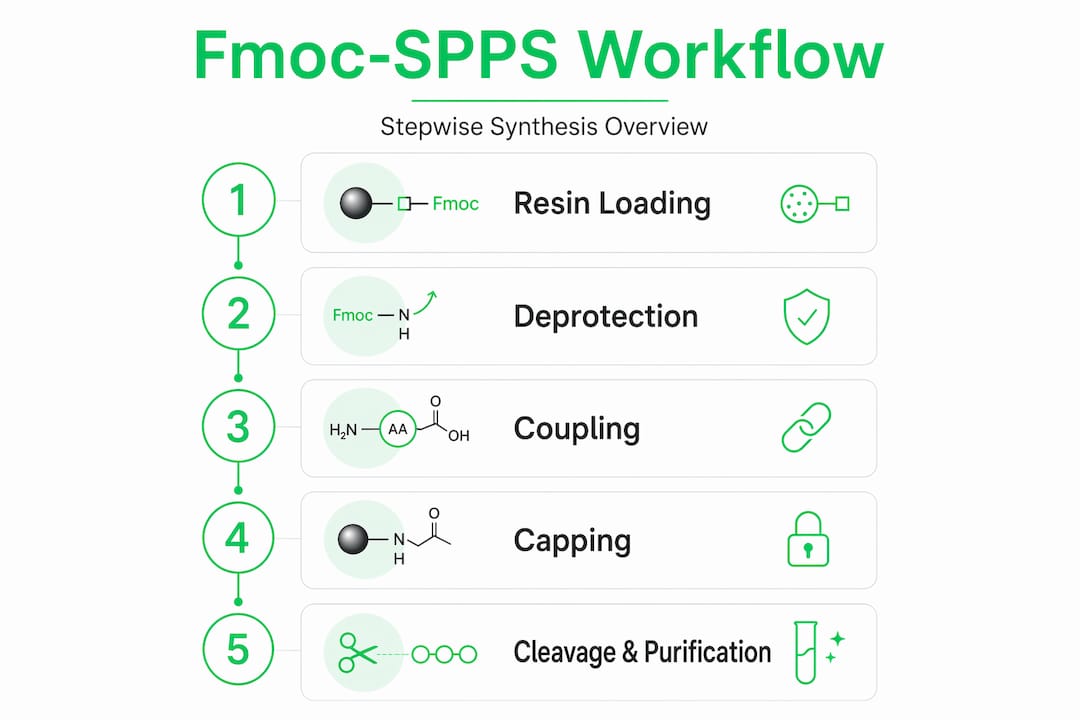
The workflow follows a repeating cycle:
- Resin loading. The first protected amino acid is covalently attached to the resin via its C-terminus. Resin choice, Wang, Rink Amide, or 2-chlorotrityl, determines your C-terminal functionality and eventual cleavage conditions.
- Fmoc deprotection. The Fmoc group on the alpha-amine is removed using 20% piperidine in DMF, a mild base that cleaves the urethane linkage. This exposes the free amine for the next coupling.
- Washing. Thorough washing between deprotection and coupling is critical. Residual piperidine interferes with coupling reagents and contributes to diketopiperazine formation in early residues.
- Coupling. The next Fmoc-protected amino acid, activated with a coupling reagent such as HBTU, HATU, or DIC with Oxyma, reacts with the free amine. Reaction completeness is everything here. 99% coupling efficiency per step gives roughly 77% overall yield for a 26-residue peptide. At 95% efficiency, that collapses to 25%.
- Capping. Unreacted amines are acetylated to prevent truncated sequences from accumulating and complicating final purification.
- Cycle repetition. Steps 2 through 5 repeat for every residue in the sequence.
- Cleavage and global deprotection. Trifluoroacetic acid (TFA) cleaves the peptide from the resin and simultaneously removes acid-labile side-chain protecting groups such as tBu and Trt. Reactive carbocations generated during this step can attack nucleophilic residues like Trp, Met, or Cys. Scavengers, typically triisopropylsilane (TIS), water, and thioanisole, are included in the cleavage cocktail to trap these intermediates before they cause damage.
Pro Tip: Run a Kaiser test (ninhydrin assay) after every coupling step during method development. A positive result (blue color) indicates free amines, meaning incomplete coupling. Catching a problematic residue early lets you double-couple before the sequence grows too long to troubleshoot efficiently.
Monitoring synthesis progress with analytical HPLC on small aliquots at key checkpoints adds another layer of quality control that pays dividends in final purity, especially for sequences longer than 20 residues.
Overcoming aggregation and side reactions
Aggregation during SPPS is not simply a consequence of long sequences. Recent research has clarified that amino acid composition is a stronger predictor of aggregation propensity than sequence patterns. This is a meaningful reframe. It means you can anticipate problems before synthesis begins by analyzing residue composition rather than waiting for a failed HPLC trace to tell you something went wrong.
The main challenges you will face:
- Aggregation. Beta-sheet-forming residues, particularly Val, Ile, Leu, Phe, and Tyr, drive on-resin aggregation. The growing chain folds prematurely, blocking reagent access and causing incomplete couplings that manifest as deletion sequences and truncated products.
- Racemization. Epimerization at the alpha-carbon during coupling reduces biological activity. Using amino acid derivatives resistant to oxazolone formation, along with suppressant additives such as HOBt or Oxyma, minimizes this risk.
- Diketopiperazine (DKP) formation. This cyclization side reaction typically occurs at the dipeptide resin stage when proline or N-methylated residues are in position two. Switching to a 2-chlorotrityl resin, which uses milder loading conditions, reduces DKP formation significantly.
- Truncated sequences. Incomplete coupling at any cycle generates a deletion sequence that co-elutes with the target peptide, complicating purification and degrading final purity.
Composition-based predictive modeling approaches now allow researchers to flag aggregation-prone sequences computationally before synthesis. Strategic substitution, replacing aggregation-prone residues with pseudoproline dipeptides or incorporating aggregation-reducing protecting groups such as Hmb on the backbone nitrogen, can rescue sequences that would otherwise fail.
Pro Tip: For sequences with three or more consecutive hydrophobic residues, consider incorporating pseudoproline (Psi Pro) dipeptide units at the first available Ser or Thr position. These introduce a temporary kink in the chain that disrupts beta-sheet formation and is easily removed during final TFA cleavage.
| Challenge | Root cause | Mitigation strategy |
|---|---|---|
| On-resin aggregation | Hydrophobic residue clustering | Pseudoproline substitution, chaotropic additives |
| Racemization | Oxazolone intermediate formation | HOBt/Oxyma additives, avoid prolonged coupling |
| DKP formation | Dipeptide cyclization at resin | 2-Chlorotrityl resin, controlled loading |
| Truncated sequences | Incomplete coupling accumulation | Kaiser test monitoring, double coupling, capping |
Regulatory quality standards for therapeutic peptides
Moving a synthesized peptide from research bench to clinical development introduces a layer of documentation and process control that many researchers underestimate. The 2025 EMA guideline on synthetic peptide manufacturing is the most specific regulatory framework currently available, and it goes substantially beyond what broader ICH guidelines address for small molecules or biologics.
Key requirements under the EMA framework include:
- Synthesis cycle documentation. Each deprotection, coupling, and washing step must be defined, with reagent identities, quantities, and reaction conditions formally specified.
- Raw material qualification. Protected amino acids, resins, coupling reagents, and solvents all require specifications covering purity, stereoisomeric integrity, and residual solvent limits.
- Impurity profiling. Stereoisomers, deletion sequences, truncated peptides, and reagent-derived impurities must be identified, characterized, and controlled to defined limits.
- Cleavage and deprotection monitoring. Analytical controls must demonstrate that cleavage is complete and that protecting groups are fully removed before downstream processing.
- Characterization package. Mass spectrometry, HPLC purity, amino acid analysis, and counterion content are minimum expected data points for therapeutic-grade peptides.
Understanding these requirements early transforms how you design your peptide synthesis methods. Building documentation habits and analytical checkpoints into your development workflow from the first campaign saves significant rework when regulatory submissions become the target.
Synthetic peptides applications across research and therapy
The synthetic peptides applications landscape has expanded well beyond classical drug discovery. Researchers now deploy custom peptide synthesis across a spectrum of scientific contexts:
- Drug discovery. Structure-activity relationship (SAR) studies rely on systematic amino acid substitution across libraries of synthetic analogs. Automated peptide synthesis platforms make parallel production of 50 to 200 variants routine.
- Epitope mapping. Overlapping peptide libraries covering full protein sequences identify antibody binding sites with single-residue resolution, a technique foundational to vaccine design and immunotherapy development.
- Biomaterials. Self-assembling peptide scaffolds, hydrogels, and surface coatings for cell culture and tissue engineering depend on precisely synthesized sequences with controlled modifications.
- Personalized therapeutics. Patient-specific neoantigen peptides for cancer immunotherapy represent one of the fastest-growing areas in personalized peptide therapy, requiring both rapid turnaround and rigorous quality documentation.
The scalability of SPPS, combined with automated platforms and AI-driven sequence design tools, is compressing timelines from sequence concept to purified material. For researchers exploring synthetic peptide benefits and risks across therapeutic contexts, that speed matters. A synthesis workflow that took weeks a decade ago can now be completed in days, with quality data attached.
My honest take on where synthesis is heading
I've watched the peptide synthesis field mature through several inflection points, and the current moment feels genuinely different. The aggregation prediction work published in Nature Chemistry in 2026 is one of the most practically useful advances in years, not because the chemistry is new, but because it reframes the problem. Researchers have treated aggregation as a sequence-specific nuisance for decades. Thinking about it as a composition-level property that you can model before you ever touch a resin is a strategic shift that will change how synthesis projects are planned.
What I've found is that the labs doing the best work don't just run SPPS. They integrate analytics, predictive tools, and regulatory thinking into their method development from day one. The researchers who struggle the most are those who treat synthesis as a black box and escalate troubleshooting only when purity is already poor.
My honest assessment of automated peptide synthesis is that it is indispensable for throughput, but it creates a false confidence about process understanding. Automation handles the repetitive cycles. It does not tell you why a sequence is failing. That still requires human interpretation of analytical data, knowledge of aggregation chemistry, and willingness to modify the synthesis design rather than just repeat failed runs.
The integration of AI into sequence design and synthesis optimization is real, but it is still early. The useful applications right now are composition-based aggregation prediction and reagent selection modeling. Full AI-driven synthesis planning is on the horizon, and when it matures, it will significantly reduce the failure rate in custom peptide synthesis campaigns.
— Sam
Take your peptide research further with Peptideai
If you are applying these synthesis principles to real therapeutic workflows, Peptideai gives you the infrastructure to manage your protocols with precision. The platform catalogs 50+ peptides including BPC-157, TB-500, and Semax, with dosing schedules backed by peer-reviewed research. The AI Insights Chatbot delivers real-time, data-grounded recommendations, so your synthesis and therapy decisions stay aligned with current evidence.

Whether you are designing a custom peptide stack or tracking outcomes across a therapy protocol, Peptideai connects your synthesis knowledge to personalized, trackable application. The AI Body Scanner and wearable integrations with Apple Health, Oura Ring, and Whoop let you close the loop between what you synthesize, what you dose, and what your biology actually does in response. Download the app on iOS or Android and put research-grade peptide intelligence to work.
FAQ
What is the most common method for peptide synthesis?
Solid-phase peptide synthesis (SPPS) using Fmoc chemistry is the most widely used method. It allows stepwise assembly on resin beads with simple wash-based purification between coupling cycles.
How does coupling efficiency affect peptide yield?
Coupling efficiency compounds multiplicatively across every residue. At 99% efficiency, a 26-amino acid peptide yields roughly 77%; at 95% efficiency, that drops to approximately 25%, making each step critical.
What causes aggregation during SPPS?
Aggregation is driven primarily by amino acid composition rather than specific sequence motifs. Hydrophobic residues like Val, Ile, and Phe cluster on the growing chain and form beta-sheet structures that block reagent access.
What regulatory framework governs therapeutic peptide manufacturing?
The 2025 EMA guideline on synthetic peptides sets specific requirements for synthesis cycle documentation, raw material qualification, impurity profiling, and analytical characterization for pharmaceutical-grade peptides.
How can I reduce racemization in peptide synthesis?
Using coupling additives like HOBt or Oxyma suppresses oxazolone intermediate formation, the primary cause of racemization. Selecting amino acid derivatives inherently resistant to epimerization also reduces stereoisomeric impurities.