
Peptides are showing up everywhere right now. From fitness forums to biohacking communities, people are self-administering compounds like BPC-157, TB-500, and Ipamorelin with minimal medical oversight. Before you follow suit, understanding what is peptide safety actually means could protect you from outcomes far worse than a wasted vial. Safety here is not just about side effects. It involves purity standards, sourcing integrity, storage conditions, and knowing which compounds have real human data behind them versus which ones were tested mostly in rodents.
Table of Contents
- Key takeaways
- What peptide safety really means
- Common peptide safety concerns
- Safe handling and storage of peptides
- Who should avoid peptides and the safety checklist
- My honest take on peptide safety
- Start your protocol the right way with Peptideai
- FAQ
Key takeaways
| Point | Details |
|---|---|
| Safety is not uniform | Peptide safety varies widely depending on the compound, its source, and how it is used. |
| Source is the top variable | Unverified vendors cannot guarantee vial contents match labels, creating contamination risks. |
| Storage affects potency and safety | Peptides degrade with light and moisture exposure, making proper storage non-negotiable. |
| Contraindications are real | Anyone with active cancer, pregnancy, or under 18 should avoid most peptide protocols. |
| Clinical data gaps matter | Most research peptides have animal data only, with no completed human trials to confirm safety. |
What peptide safety really means
The phrase "peptide safety" gets used loosely online, but peptide safety explained properly means evaluating three distinct things: the purity of the compound, the strength of the clinical evidence behind it, and the risk profile relative to your personal health status.
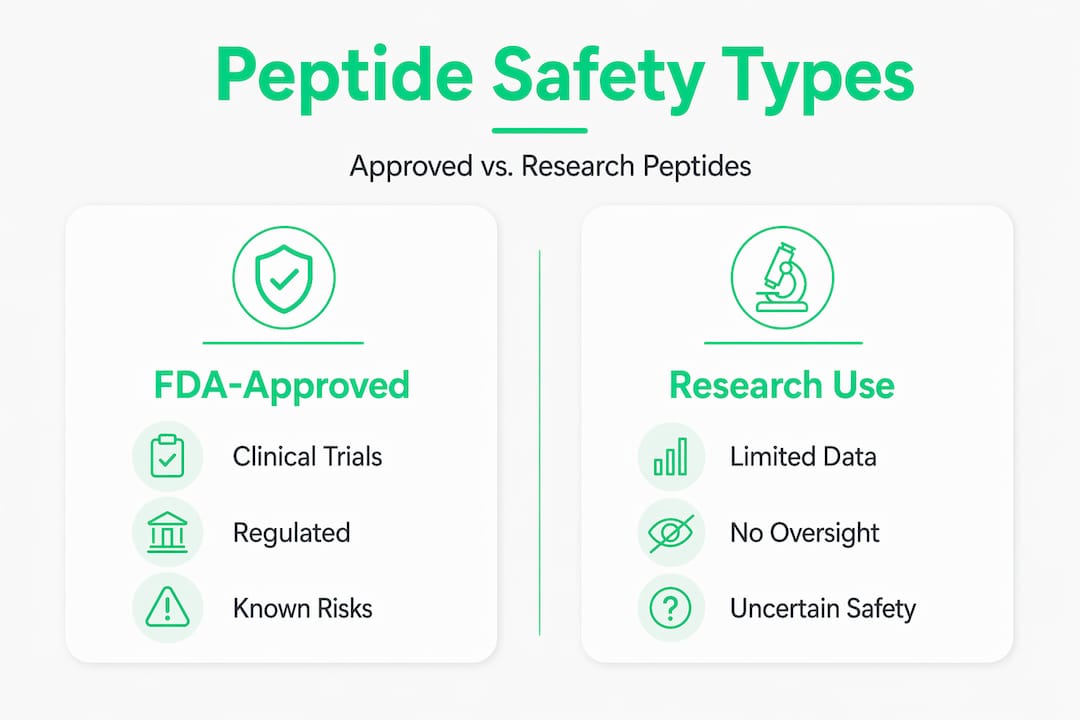
Not all peptides sit in the same category. On one end, you have FDA-approved peptides like semaglutide or tesamorelin, which carry data from tens of thousands of clinical trial participants. On the other end, research peptides lack human trials, meaning their long-term effects in humans are genuinely unknown. That distinction is not semantic. It changes everything about how cautiously you should approach a given protocol.
| Category | Examples | Human trial data | Regulatory status |
|---|---|---|---|
| FDA-approved peptides | Semaglutide, Tesamorelin | Extensive (tens of thousands) | Approved for specific indications |
| Research peptides | BPC-157, TB-500, Semax | Mostly animal data | Not approved for human use |
| Peptide hormones | HGH, insulin | Extensive | Controlled substances or prescription only |
The table above matters because a lot of biohackers conflate "has a lot of positive anecdotes online" with "is safe." Those are very different claims. Safety is not uniform across peptides. Growth factor peptides, for instance, carry unique risks that do not apply to a peptide like Semax, which acts on the central nervous system through an entirely different mechanism.
For a deeper look at how terminology gets misapplied in this space, the peptide terms decoded guide by Peptideai breaks down common definitions with clinical context.
Common peptide safety concerns
Side effects from peptides are real and more frequent than most fitness forums suggest. Nausea affects 20 to 44% of users on certain growth hormone secretagogues. Fatigue, headaches, water retention, and joint discomfort are also commonly reported, depending on the compound and dosage.
The side effects that get the least attention are immunological ones. Injection site redness, itching, and localized swelling are often dismissed as minor nuisances, but they signal a localized immune response. In most cases this is non-allergic in nature and manageable with proper technique. Injecting slowly, rotating sites, and controlling injection volume all reduce the frequency and severity of these reactions.
Then there is the sourcing problem, which is arguably the biggest safety risk of all.
- Contamination: Grey-market peptides may contain bacterial endotoxins, heavy metals, or solvents from uncontrolled synthesis environments.
- Mislabeling: Unregulated vendors cannot guarantee that vial contents match the label, meaning you may be injecting something entirely different from what you ordered.
- Dosing inconsistency: Without third-party testing, potency per milligram is unknown, making accurate dosing impossible.
- Cancer risk potential: Grey-market peptides pose risks including possible acceleration of cancer cell growth, particularly relevant for growth factor compounds.
"Patients often rely on social media rather than clinical evidence when evaluating peptide safety. The absence of reported side effects online is not proof that a compound is safe." AMA
Pro Tip: Before purchasing any peptide, ask the supplier for a certificate of analysis (COA) from a third-party lab. If they cannot provide one, do not buy from them.
For a look at how synthetic peptides specifically differ in their risk profiles, the synthetic peptides guide from Peptideai covers this well.
Safe handling and storage of peptides
Getting the compound right is only half the equation. How you store and handle it determines whether the peptide you inject is still active and safe by the time it reaches your body. This section covers what most beginners get wrong.

Storage conditions
Peptides are fragile molecules. They are highly hygroscopic and light-sensitive, meaning moisture and light both degrade their structure over time. Lyophilized (freeze-dried) peptides should be stored in opaque containers, ideally in a desiccator before reconstitution, and kept at or below -20°C for long-term storage. Once reconstituted, most peptides are stable for 2 to 4 weeks at 4°C.
One critical rule that gets skipped: allow vials to reach room temperature before opening them. The temperature difference between a cold vial and ambient air causes condensation inside the container. That moisture degrades potency and efficacy even before you have touched the peptide.
Reconstitution and injection
- Use bacteriostatic water (BAC water) for multi-dose vials. BAC water contains 0.9% benzyl alcohol, which prevents bacterial colonization after the vial is punctured. Plain sterile water allows dangerous bacterial growth within hours of the first use.
- Add BAC water slowly along the inside wall of the vial. Do not inject it directly onto the lyophilized powder. Swirl gently. Never shake.
- Use a new, sterile insulin syringe for every injection. Re-using needles increases infection risk and degrades injection accuracy.
- Rotate injection sites systematically. Subcutaneous injections can be made into the abdomen, thigh, or outer arm. Rotating reduces localized immune responses and tissue irritation.
- Inject slowly. Rapid injection increases the likelihood of localized immune activation.
- Dispose of all sharps in a proper sharps container. This is a legal and safety requirement in most states.
Pro Tip: Label every reconstituted vial with the date of preparation and the concentration. Peptide solutions look identical regardless of what they contain or how old they are.
| Storage state | Recommended temperature | Stability window |
|---|---|---|
| Lyophilized (sealed) | -20°C or below | 12 to 24 months |
| Lyophilized (refrigerated) | 4°C | 3 to 6 months |
| Reconstituted solution | 4°C | 2 to 4 weeks |
| Room temperature (in use) | Under 25°C | Use within 4 hours |
Who should avoid peptides and the safety checklist
Peptide safety guidelines need to address who should not use these compounds at all. This is where the online community tends to be dangerously optimistic.
Key contraindications
- Active or recent cancer history: Growth-factor peptides should be avoided by anyone with active or recent malignancy. Compounds that upregulate IGF-1 or other growth factors may accelerate cellular proliferation.
- Pregnancy and breastfeeding: There is zero human safety data for peptide use during pregnancy. This is a hard stop.
- Age under 18: Growing bodies have fundamentally different hormonal environments. Introducing exogenous peptides at this stage carries unknown developmental risks.
- Active systemic infections: Injecting any compound into the body during an active infection compounds immune burden and increases complication risk.
- Unmanaged autoimmune conditions: Some peptides interact with immune signaling pathways in ways that may exacerbate flare-ups.
Pre-protocol safety checklist
Work through this before starting any peptide protocol:
- Have you consulted a physician or qualified healthcare provider?
- Do you know the specific mechanism of the peptide you plan to use?
- Have you verified the supplier's certificate of analysis?
- Do you have bacteriostatic water, sterile syringes, and a sharps container ready?
- Are you tracking biomarkers like IGF-1, liver enzymes, or cortisol as a baseline?
- Have you ruled out all contraindications listed above?
- Do you have a clear protocol with defined dose, frequency, and cycle length?
Pro Tip: Do not start two new peptides simultaneously. If a side effect occurs, you will have no way of identifying which compound caused it. Introduce one peptide at a time and wait at least two weeks before adding another.
For beginners who need to start with low-risk options before building toward complex stacks, the best peptides for beginners guide from Peptideai is a practical starting point.
My honest take on peptide safety
I have spent years working with people who approach peptide use with a mix of genuine curiosity and surprising overconfidence. The pattern I see most often is someone who has done a lot of research on effects and almost no research on safety. They know what BPC-157 might do for tendon repair. They have no idea whether their source has ever had a product tested.
What I find genuinely concerning is how the absence of negative online reviews has become a substitute for safety data in many biohacking communities. That is a category error. People rarely post about a contamination event because they often cannot confirm one happened. Subclinical bacterial exposure does not always announce itself with obvious symptoms.
My other observation: most unsafe peptide experiences I have seen trace back to one of two things. Either the source was unverified, or the user skipped the basics of reconstitution and storage. Neither of those failures is exotic. Both are entirely preventable with the right information.
Evidence-based decision-making in this space means respecting the gap between "promising animal data" and "proven in humans." That gap is real. It does not mean peptides are inherently dangerous. It means you need to be honest about what you know, what you do not know, and how you are managing that uncertainty.
— Sam
Start your protocol the right way with Peptideai
If you have gotten this far, you already understand that peptide safety is not a single checkbox. It is a system of decisions, from sourcing and storage to dosing and monitoring.

Peptideai is built specifically for people who want to take peptide use seriously. The app gives you access to AI-powered protocol management tools with peer-reviewed research behind every recommendation, biometric tracking that connects with Apple Health, Oura Ring, and Whoop, and a catalog of 50+ peptides including BPC-157, TB-500, and Semax. Whether you are building your first stack or refining an existing protocol, Peptideai puts research-grade intelligence directly in your pocket. Stop guessing. Start tracking.
FAQ
What does peptide safety mean for personal users?
Peptide safety refers to evaluating a compound's purity, clinical evidence, and personal risk factors before use. For personal users, it also includes sourcing verification, proper storage, and correct injection technique.
Are peptides safe to use without a doctor?
Many research peptides are used without medical supervision, but this carries real risks. Without medical oversight you cannot adequately screen for contraindications, monitor biomarkers, or verify compound purity.
How should peptides be stored to maintain safety?
Lyophilized peptides should be stored at or below -20°C in opaque, moisture-protected containers. Once reconstituted with bacteriostatic water, keep solutions refrigerated at 4°C and use within two to four weeks.
What are the biggest risks of buying peptides online?
The top risks include contamination, mislabeling, and unknown potency. Buying from unverified online sources provides no assurance that vial contents match the label.
Who should not use peptides?
Anyone with active cancer, a history of recent malignancy, pregnancy, age under 18, active systemic infection, or unmanaged autoimmune conditions should avoid peptide use until cleared by a healthcare provider.