
Peptide AI is reshaping how serious health optimizers approach therapy protocols, but the gap between what AI tools can actually do and what most people expect from them is significant. You have probably seen the claims: AI designs your perfect peptide stack, dials in your dosing automatically, and eliminates the need for clinical oversight. The reality is more nuanced, more interesting, and honestly more useful to understand. This guide cuts through the noise and gives you a grounded view of how peptide AI works, where it genuinely delivers, what the regulatory environment looks like in 2026, and how to use these tools without exposing yourself to unnecessary risk.
Table of Contents
- Key Takeaways
- What peptide AI actually is and how it works
- Regulatory landscape and safety in 2026
- Scientific foundations of AI in peptide design
- Using peptide AI tools for personalized health
- My honest take on peptide AI and where it falls short
- Take your peptide protocol further with Peptideai
- FAQ
Key Takeaways
| Point | Details |
|---|---|
| Peptide AI is a tool, not a clinician | AI apps manage protocols and track biometrics but cannot replace medical supervision or clinical validation. |
| FDA restrictions are real and recent | 19 popular peptides were moved to Category 2 between 2023 and 2024, cutting off legal compounding supply chains. |
| AI accelerates discovery, not approval | AI reduces preclinical timelines significantly but clinical trials and FDA review timelines remain unchanged. |
| Data quality determines AI output quality | The better your biometric and lab data inputs, the more useful your AI-generated protocol recommendations will be. |
| Sourcing peptides from unlicensed vendors carries legal risk | Research chemical suppliers may circumvent FDA restrictions but expose you to serious safety and legal exposure. |
What peptide AI actually is and how it works
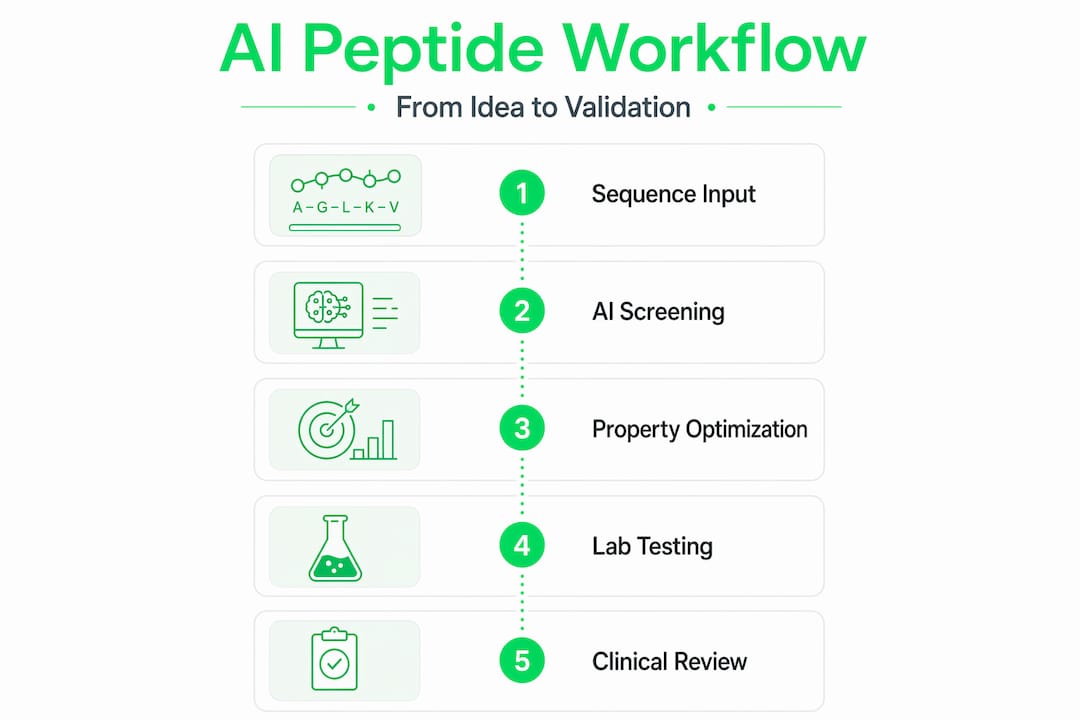
The phrase "peptide AI" gets used to describe two very different things, and conflating them causes a lot of confusion. At the research and pharmaceutical level, AI in peptide research refers to machine learning models that predict how peptide sequences will fold, bind, and behave. These tools are used by drug developers to design candidate molecules through generative models that optimize binding affinity, solubility, permeability, and stability across millions of possible sequences faster than any lab team could manually screen.
At the consumer level, peptide AI refers to protocol management apps that use AI to help you build, track, and adjust personal peptide therapy regimens. These are not the same category, and knowing the distinction matters when you evaluate what a tool is actually offering you.
Consumer-facing peptide AI tools typically include:
- Protocol building: Structured stacks with dosing schedules for peptides like BPC-157, TB-500, Semax, and others from a cataloged library
- Biometric integration: Syncing with wearables like Apple Health, Oura Ring, and Whoop to correlate peptide use with sleep, HRV, and recovery metrics
- AI insights and chatbots: Real-time recommendations based on your logged data and peer-reviewed research
- Pharmacokinetic visualization: Curve modeling that shows how peptide concentrations change over your dosing schedule
- Injection site rotation tracking: Logged guidance to minimize tissue fatigue
Apps with these features offer protocol management and biomarker tracking but are not classified as medical devices. They do not replace clinical oversight. Think of them the way you would think about a fitness tracking app compared to a cardiologist. The app gives you organized, data-backed information. The clinician interprets it in the full context of your health.
Pro Tip: Before you download any peptide AI app, check whether it cites peer-reviewed research in its recommendations. Apps that link their suggestions to published studies give you a verifiable baseline; apps that do not are essentially guessing on your behalf.
Regulatory landscape and safety in 2026
This is where a lot of peptide enthusiasts get blindsided. The regulatory environment changed significantly between 2023 and 2024, and if your information is older than that, your assumptions about what is legally available may be wrong.
The FDA moved a substantial number of popular peptides into Category 2, which means licensed compounding pharmacies under 503A and 503B frameworks can no longer legally prepare them. 19 peptides including BPC-157 and TB-500 were classified this way due to safety concerns and insufficient clinical data. This includes compounds many practitioners and users have relied on for years.
Here is what that practically means for you:
- Legal compounding is restricted. Even if a physician writes a prescription for a Category 2 peptide, a licensed 503A compounding pharmacy cannot fill it legally under current rules.
- "Not FDA approved" does not mean illegal, but Category 2 does change the picture. Prescribing prohibited peptides under 503A or 503B frameworks exposes prescribers to enforcement risk, not just patients.
- Research chemical vendors fill the gap but carry real risk. When legal supply chains get cut off, users often turn to research-only vendors. These sources are not subject to the same quality controls, USP 797 compliance requirements, or beyond-use dating standards that licensed pharmacies must follow.
- Documentation matters even when sourcing is compliant. Maintaining records of medical necessity, provider oversight, and sourcing decisions is increasingly important as regulatory oversight for compounded peptides tightens to protect patients.
- AI-generated protocols do not confer legal or clinical compliance. An app suggesting a dosing protocol for a restricted peptide does not make that protocol legal or safe to follow without qualified clinical guidance.
"Not FDA approved" and "Category 2 prohibited" are not the same legal status. Category 2 means the FDA has specifically determined that the peptide presents safety concerns serious enough to prohibit licensed compounding. That distinction has real legal weight.
The practical upshot: always verify the regulatory status of any peptide you are researching before sourcing it. Peptide compliance resources for physicians are now available to help providers navigate these frameworks, and as a patient or user, you benefit from working with clinicians who are current on these distinctions.
Scientific foundations of AI in peptide design
Understanding what AI can and cannot do in peptide discovery gives you realistic expectations and protects you from hype-driven decisions.
| What AI does well | What AI cannot replace |
|---|---|
| Screen millions of sequences rapidly | Wet-lab validation of binding and toxicity |
| Optimize multi-parameter drug properties | Immunogenicity testing in living systems |
| Generate novel candidate peptides from scratch | Phase I, II, III clinical trial data |
| Reduce preclinical timelines significantly | FDA review and regulatory approval |
| Predict solubility and permeability in silico | Real-world pharmacokinetic confirmation |
The numbers here are genuinely impressive. AI reduces preclinical development from three to four years down to thirteen to eighteen months. That is a meaningful compression of timeline in the early stages. But clinical trials still take as long as they always have, and the FDA's review process has not shortened. The total time from molecule to market has not collapsed the way some early headlines suggested it would.

The deeper problem is what researchers call the "valley of death." No AI-designed peptide has received FDA approval yet, and many candidates that look exceptional in preclinical data fail in human trials because of immunogenicity or unexpected toxicity. The models are getting better, but they are predicting behavior in silico. Biology in a living human is considerably more complex.
AI-driven design uses generative models that can simultaneously optimize multiple properties, which is a genuine leap forward for early-stage research. Peptide sequencing AI and peptide synthesis AI tools have shortened the iterative cycle between hypothesis and candidate dramatically. But the primary bottleneck is not discovery speed anymore. It is the FDA-required validation process that cannot yet be replaced by computational tools, no matter how sophisticated they become.
Pro Tip: When you read about a breakthrough in AI-driven peptide therapies or peptide discovery AI, look for whether the compound has entered Phase I trials. Preclinical success in animals or in silico models is genuinely exciting, but it is not the same as human safety data. Many promising peptide candidates fail at that first human hurdle.
The honest framing for AI in peptide research is this: AI is an accelerator for the front end of the pipeline, not a shortcut through the entire process. That is valuable. It is just not the same as having approved, human-validated therapies ready to use today.
Using peptide AI tools for personalized health
Assuming you are working within the legal and regulatory boundaries outlined above, peptide AI apps can add real, practical value to your self-optimization stack. The key is using them intelligently rather than treating their outputs as clinical prescriptions.
When selecting a peptide AI app, look for these features:
- Cataloged peptide library with research citations: You want recommendations grounded in published science, not algorithmic guesses with no sourcing
- Wearable and health data integration: Apps that pull in HRV, sleep, and recovery data from Apple Health, Oura, or Whoop allow the AI to correlate protocol timing with actual physiological response
- Dose logging with pharmacokinetic modeling: Knowing when concentrations peak and trough helps you time peptides for performance or recovery windows
- Biomarker tracking alignment: For peptides aimed at body composition, inflammation, or hormonal support, the ability to track peptide biomarkers over time creates a feedback loop that improves protocol accuracy
- Injection site guidance: Rotation tracking is a small but genuinely useful feature that reduces injection site irritation on longer protocols
AI-enabled systems have demonstrated meaningful recovery benefits. AI-integrated wearable systems showed 25% faster wound healing in preclinical trials compared to standard care, pointing toward where real-world AI integration is heading. That is not a consumer app claim. It is a preclinical finding that signals the direction of the technology.
Data privacy is worth taking seriously before you commit to any platform. You are inputting detailed biometric information, injection logs, and potentially lab results. Understand what the app does with that data, whether it is stored locally or in the cloud, and what its sharing policies are.
Pro Tip: Use your peptide AI app as a documentation tool even before you rely on it for recommendations. Logging your protocols, response data, and biomarker trends creates a personal dataset that becomes genuinely valuable over time, both for your own pattern recognition and for conversations with your prescribing physician.
Understanding safe peptide administration techniques matters just as much as the protocol itself. No AI tool can compensate for poor injection technique, incorrect reconstitution, or improper storage.
My honest take on peptide AI and where it falls short
I have spent a lot of time with both the science and the consumer side of this space, and the thing I keep coming back to is how much damage unchecked enthusiasm does here. Not malicious damage. Just the natural human tendency to hear "AI" and assume the hard problems have been solved.
What I have actually seen is this: peptide AI tools, used thoughtfully, are genuinely useful. The protocol management, the biometric correlation, the research-backed dosing guidance. These features reduce the error rate that comes from building protocols from scattered forum posts and outdated blog content. That is a real improvement.
But I have also seen people use AI-generated protocols as permission slips to skip clinical oversight entirely. That is where things go wrong. An app recommending a dosing schedule for a peptide your physician has not reviewed is not a safer version of medical guidance. It is a more organized version of guessing.
The regulatory piece is the part that genuinely concerns me. A lot of users have not internalized that the peptides they sourced legally in 2022 may now come from research chemical vendors with no quality controls. The FDA classification changes that happened between 2023 and 2024 were significant, and many people operating on older information are taking risks they do not fully understand.
My advice is to use AI tools to get smarter about your protocols, track your data rigorously, and bring better questions to your clinical appointments. Not to replace those appointments. The technology will keep improving. But the biology you are working with right now does not wait for the science to catch up.
— Sam
Take your peptide protocol further with Peptideai
If you are serious about building a protocol that tracks, adapts, and actually reflects your biology, Peptideai was built specifically for this.
The Peptideai platform combines an AI Insights Chatbot backed by peer-reviewed research, a cataloged library of 50+ peptides including BPC-157, Semax, and TB-500, and full integration with Apple Health, Oura Ring, and Whoop. You get pharmacokinetic curve visualization, injection site rotation tracking, and an AI Body Scanner to monitor physical transformation over time. Every recommendation is tied to actual research, not algorithmic approximation. Unlike generic wellness apps, Peptideai is purpose-built for peptide therapy with personalized dosing insights that adapt as your data grows. Available on iOS and Android. Your biology is already generating data. Peptideai helps you use it.
FAQ
What does peptide AI actually do for users?
Peptide AI tools help users build, track, and adjust personalized peptide therapy protocols by integrating biometric data, AI-powered dosing recommendations, and peer-reviewed research into a single platform.
Are peptide AI apps considered medical devices?
No. Consumer peptide AI apps provide protocol management and data tracking but are not classified as medical devices and do not replace clinical oversight or physician guidance.
Which peptides are currently restricted by the FDA?
The FDA moved 19 peptides including BPC-157, TB-500, CJC-1295, and Ipamorelin to Category 2 between 2023 and 2024, prohibiting licensed compounding pharmacies from preparing them.
Has any AI-designed peptide been FDA approved?
Not yet. No AI-designed peptide has received FDA approval, as most candidates still face significant hurdles in human clinical trials related to immunogenicity and toxicity.
How does peptide AI use biometric data to improve protocols?
Peptide AI apps sync with wearables to correlate dosing schedules with real-time physiological data like HRV, sleep quality, and recovery scores, allowing the AI to refine timing and dosage recommendations over time as your personal dataset grows.