
If you've spent any time researching peptides for health, performance, or recovery, you've likely hit a wall of confusing compound names, vague sourcing pages, and zero useful context. Explaining peptide catalog structure and function is where that confusion ends. A peptide catalog is the primary tool researchers and informed users rely on to identify, compare, and select compounds with confidence. Understanding how these catalogs are built, what data they contain, and how to read them separates productive research from expensive guesswork. This article gives you that foundation.
Table of Contents
- Key takeaways
- Explaining peptide catalog structure and function
- Technical specs every catalog entry should include
- FDA regulations and what they mean for catalog users
- How to actually use a peptide catalog
- My honest take on what catalogs get right and get wrong
- Find your peptides with confidence using Peptideai
- FAQ
Key takeaways
| Point | Details |
|---|---|
| Catalogs are structured tools | A peptide catalog organizes compounds by category, specs, and regulatory status to speed selection. |
| Technical specs are non-negotiable | Purity, molecular weight, and sequence data determine whether a compound is suitable for your application. |
| FDA status belongs in every catalog | Knowing which peptides are approved, experimental, or banned from compounding protects your research and health. |
| Filters cut selection time dramatically | Using category and purity filters in a well-built catalog reduces compound selection from hours to minutes. |
| Catalogs require expert context | No catalog replaces clinical or laboratory guidance. Use them as a starting point, not a final decision. |
Explaining peptide catalog structure and function
A peptide catalog is a structured database or organized listing of peptide compounds, each entry containing the data a researcher or user needs to evaluate whether that compound fits their purpose. Think of it as the periodic table of peptides. Instead of scanning through scattered supplier pages or academic abstracts, you get one organized resource where every compound sits in context.
Peptide catalogs are strategic tools that improve workflow and decision-making speed in scientific environments. That distinction matters. A simple product list is not a catalog. A real catalog structures data so you can filter, compare, and select with precision.
What separates a functional catalog from a disorganized one comes down to a few core features:
- Clear categorization by peptide function (growth factors, neuropeptides, repair peptides, metabolic peptides)
- Detailed compound entries that include purity grade, molecular weight, amino acid sequence, and storage conditions
- Search and filter tools that let you narrow by chain length, application area, or regulatory status
- Regulatory flags indicating FDA approval status, experimental classification, or compounding restrictions
- Sourcing and synthesis notes that tell you how the compound was made and to what standard
Structured catalogs reduce decision time from hours to minutes and cut the risk of selecting the wrong compound entirely. That is not a minor efficiency gain. In a research context, a misidentified compound wastes reagents, time, and potentially produces misleading data. For an individual pursuing peptide therapy, the stakes are physiological.
Peptides sit between amino acids and full proteins in size, which makes them uniquely suited to interact with receptors in the body. That receptor specificity is also why selecting the right compound matters so much. Two peptides with similar names can have completely different mechanisms.
Pro Tip: When evaluating any peptide catalog, look for a dedicated regulatory status column first. If that information is absent, the catalog was built for marketing rather than research.
Technical specs every catalog entry should include
This is where most newcomers get lost. The technical layer of a peptide catalog looks intimidating, but each data point has a direct, practical purpose.

Purity, weight, and sequence
Professional catalogs include purity levels at or above 98% along with exact molecular weight and amino acid sequence details. Without these specs, a catalog entry is functionally useless for research. Here is what each field tells you:
- Purity percentage indicates how much of the compound is actually the intended peptide versus synthesis byproducts. For in vivo research or clinical use, anything below 95% purity introduces unacceptable variables.
- Molecular weight (expressed in Daltons) helps confirm compound identity and affects dosing calculations. A slight error here cascades into dosing errors downstream.
- Amino acid sequence is the defining characteristic of the peptide. Catalogs that omit this are not suitable for rigorous work.
- Counterion type (acetate vs. trifluoroacetate salt form) affects solubility and can influence bioactivity. This detail often separates research-grade catalogs from commodity listings.
- Storage conditions tell you how stable the compound is and what handling protocols apply, which directly affects shelf life and experimental reproducibility.
Research-grade vs. human-use peptides
The catalog should make this distinction explicit. Research-grade peptides are manufactured and tested for laboratory use. They are not sterile, not FDA-evaluated for human administration, and not held to pharmaceutical manufacturing standards. Human-use peptides, by contrast, come from compounding pharmacies operating under medical oversight.
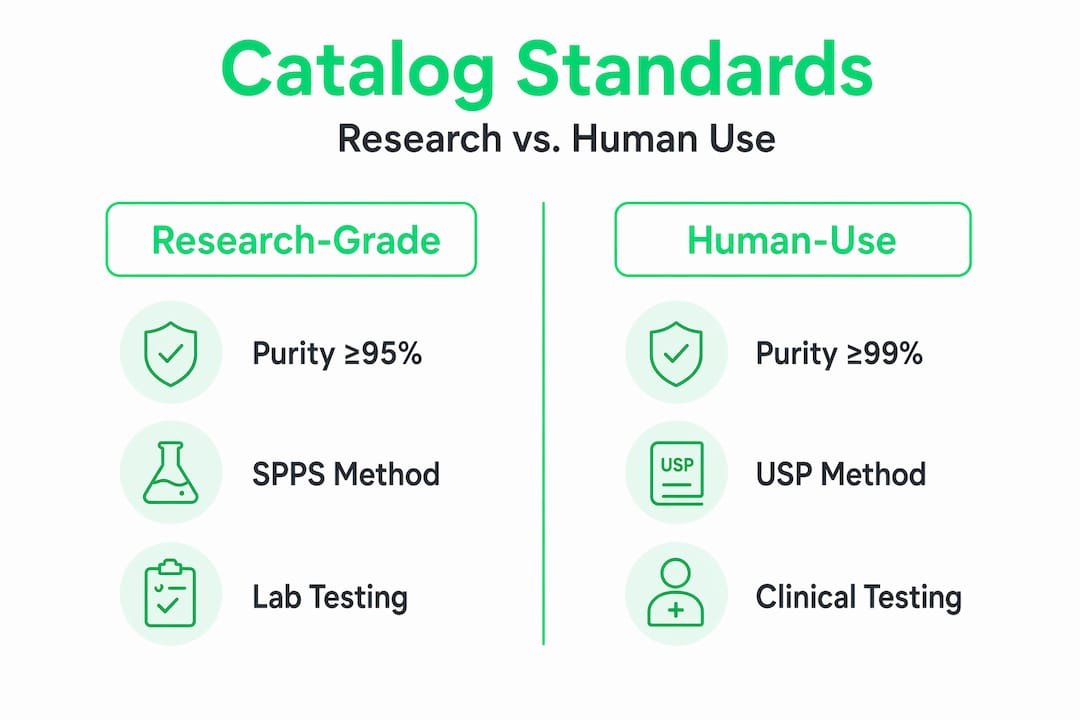
SPPS is the dominant synthesis method, capable of producing peptides up to 40 to 50 amino acids in length. Many catalogs reference synthesis method because it directly relates to quality and cost. Hybrid SPPS and LPPS approaches have emerged to reduce waste and increase purity for longer chains, and catalogs from quality suppliers will note which approach was used.
| Spec | Research-grade standard | Human-use standard |
|---|---|---|
| Purity | ≥95% typical | ≥99% required |
| Sterility | Not required | Required |
| Regulatory oversight | None | FDA and state board |
| Source | Chemical supplier | Licensed compounding pharmacy |
| Documentation | CoA (Certificate of Analysis) | Full pharmaceutical-grade batch record |
Pro Tip: Always request or download the Certificate of Analysis (CoA) linked in a catalog entry before ordering. A catalog without accessible CoA documentation is a red flag regardless of how polished the listing looks.
FDA regulations and what they mean for catalog users
This is the section most catalog users skip, and it's the one that matters most for safety. The regulatory status of a compound determines not only whether it's legal to use, but whether the risk profile has been evaluated by anyone with accountability.
In 2023, the FDA moved 19 popular peptides to a "do not compound" list, citing concerns around safety, contamination risks, and lack of adequate clinical data. That action fundamentally changed which compounds could be legally compounded and prescribed in the US.
"The risks include pancreatitis, immune reactions, and potential cancer risks with unapproved peptides."
— American Medical Association
For catalog users, this means a listing without a regulatory status field is not just incomplete. It could expose you to compounds that are now restricted. A well-maintained catalog updates these flags in real time as regulatory guidance changes.
Here is what to look for in a catalog's regulatory section:
- FDA-approved: The peptide has cleared clinical trials and is approved for specific indications (semaglutide, for example)
- Experimental/investigational: Compounds with active research but no approved human indication
- Compounding-restricted: Peptides on the FDA's "do not compound" list, requiring special medical justification
- Gray-market: Not technically in most reputable catalogs, but important to recognize. These appear on less regulated supplier sites.
Gray-market peptides lack rigorous testing and may be contaminated or incorrectly dosed, posing real health risks. Experts consistently emphasize distinguishing between well-studied, FDA-approved peptides and unregulated experimental compounds circulating online. The catalog you use should make that distinction obvious, not obscure it.
Newer anti-aging or recovery peptides often lack human trial data with unclear dosing and safety profiles, despite widespread online availability. That reality makes catalog transparency not just useful, but protective.
Pro Tip: Before beginning any peptide protocol, cross-reference the compound's name against the current FDA compounding restrictions list. Reputable catalogs will link directly to this documentation within the entry.
How to actually use a peptide catalog
Reading a catalog effectively is a skill. Most people open one, feel overwhelmed by the data density, and default to searching by name only. That approach misses most of the catalog's value.
Here is a practical workflow for getting the most out of any peptide catalog:
- Start with your application, not the compound name. Filter by function first: injury recovery, cognitive support, metabolic regulation, or immune modulation. This narrows a catalog of 500 compounds to a relevant subset immediately.
- Set a purity floor. If your work requires reproducibility, filter for 98% purity minimum before reading any other spec. This eliminates entries that will not perform consistently.
- Check regulatory status before reading further. If the compound is restricted or gray-market, move on. No clinical benefit is worth working outside legal and medical frameworks.
- Compare molecular weight and sequence across similar compounds. Peptides with similar names but different sequences have different biological activity. The sequence column tells you what you're actually getting.
- Download and review the Certificate of Analysis. This document shows the actual batch test results, not just what the manufacturer claims. Look for third-party testing verification.
- Check for clinical context or referenced studies. Quality catalogs link to or cite the research supporting the compound's known applications. This gives you a realistic picture of what is evidence-based versus experimental.
Filtering by purity, sequence length, or function speeds selection and improves accuracy measurably. You can also explore peptide classifications organized by function or amino acid sequence to build further context alongside your catalog research.
The one step most people skip entirely: integrating catalog findings with clinical or laboratory guidance. A catalog tells you what a compound is. A qualified clinician or researcher tells you whether it belongs in your protocol. Those are two very different answers to two different questions.
My honest take on what catalogs get right and get wrong
I've spent a lot of time with peptide data, and the pattern I see repeatedly is this: people treat catalog listings as endorsements. They find a compound, see a 98% purity rating and a citation or two, and interpret that as "safe and validated." That is a significant misread.
In my experience, even the best-structured catalogs are tools for identification, not authorization. What a catalog gives you is the correct information about what a compound is. It does not tell you what that compound will do in your specific physiology, at your specific dose, alongside your specific health context. That requires human expertise.
What I've found genuinely useful about well-built catalogs is the regulatory transparency they can provide, when they commit to it. The catalogs that clearly flag compounding restrictions, link to batch testing, and separate research-grade from human-use compounds save researchers and users from mistakes that are both costly and potentially dangerous.
The catalogs I distrust most are the ones optimized to look comprehensive without doing the work of actual curation. Long compound lists with no purity data, no regulatory flags, and no synthesis information are not catalogs. They are product pages pretending to be research tools.
My view: use catalogs as your starting filter, not your ending point. Pair catalog research with peptide research foundations and always close the loop with qualified guidance before committing to any protocol.
— Sam
Find your peptides with confidence using Peptideai

If you're serious about putting catalog knowledge into practice, Peptideai was built for exactly this. The platform catalogs 50+ peptides, including BPC-157, TB-500, and Semax, with detailed specifications, dosing schedules, and real-time AI-powered insights drawn from peer-reviewed research. Every compound entry is paired with the kind of technical and regulatory context this article has outlined.
Beyond the catalog itself, Peptideai integrates with Apple Health, Oura Ring, and Whoop so your biometric data informs your protocol, not the other way around. The AI Insights Chatbot answers compound-specific questions in real time. The AI Body Scanner tracks physical change over time. This is what understanding peptide catalogs looks like in actual practice. Download the app on iOS or Android and bring the research-grade intelligence directly into your protocol.
FAQ
What is a peptide catalog?
A peptide catalog is a structured database of peptide compounds that includes technical specifications like purity, molecular weight, amino acid sequence, and regulatory status, allowing researchers and users to identify and compare compounds efficiently.
How do I use a peptide catalog to find the right compound?
Start by filtering on your application area, then set a minimum purity threshold, check the compound's FDA regulatory status, and download the Certificate of Analysis before making any selection decision.
Why does purity matter in a peptide catalog entry?
Purity determines how much of a batch is actually the intended compound. For research or clinical use, purity below 95% introduces contaminants that alter results and increase safety risk.
What does it mean if a peptide is on the FDA "do not compound" list?
It means the FDA has determined the compound poses unacceptable safety risks when compounded, including concerns around contamination, incorrect dosing, or adverse effects like immune reactions or pancreatitis.
Are all peptide catalogs equally reliable?
No. Reliable catalogs include purity data, synthesis method, regulatory status, and third-party batch testing documentation. Catalogs that omit these details are not suitable for research or informed personal use.